
India has produced silk for over four thousand years and remains the second-largest producer in the world. Most of the country's output is mulberry silk from the southern and eastern states, woven into the Kanjivaram saris of Tamil Nadu, the Banarasi brocades of Uttar Pradesh and the Baluchari weaves of West Bengal.
North East India is located outside this mulberry belt with a tradition of its own. Assam is the only Indian state that produces three native silks together, Muga, Pat and Eri, all reared, reeled and woven within the region. The Brahmaputra Valley provides the host trees and climate these silkworms need, and the surrounding villages have kept the weaving traditions alive for centuries.

The warm, humid climate of the Brahmaputra Valley supports year-round Muga rearing in a way few other Indian regions can match.
Why is Assam known for silk?
Assam has been producing silk for over two thousand years, with references to Assamese cloth appearing in the Arthashastra, the 3rd-century BC political treatise attributed to Kautilya. The industry grew further under the Ahom kings, who ruled the region from the 13th to the 19th centuries and tied silk weaving to royal patronage. By the colonial period, Sualkuchi had become the principal weaving centre in the state, and the craft had settled into the household industry that still operates today.
This continuity has a lot to do with the land itself. The conditions in the Brahmaputra Valley suit silk rearing better than almost anywhere else in India. The som and soalu trees that feed the Muga silkworm grow naturally across upper Assam, castor for Eri silkworms is cultivated widely by tribal communities, and the warm, humid climate of the valley supports rearing through most of the year. These conditions have kept Assam at the centre of India's non-mulberry silk industry, and the state still accounts for nearly the entire national output of Muga.
What are the three types of silk in Assam?
The three types of silk produced in Assam are Muga, Pat and Eri. Each comes from a different species of silkworm, uses a different host plant, and produces cloth with its own distinct colour and weight. Together they form the muga pat eri silk group, and they cover almost all the Assam silk types recognised in Indian textile classification.
Muga comes from the Antheraea assamensis silkworm, which feeds on som and soalu leaves, and the thread is naturally golden, strong, and takes on a deeper sheen with each wash. Pat is produced by Bombyx mori, the same species used for mulberry silk across India, but the Assamese strain yields a fine, glossy white or off-white thread used in formal dress. Eri is reared from the Samia ricini silkworm, which feeds on castor leaves, and the yarn is spun rather than reeled, producing a soft, matte cloth closer to wool in handle than to conventional silk.
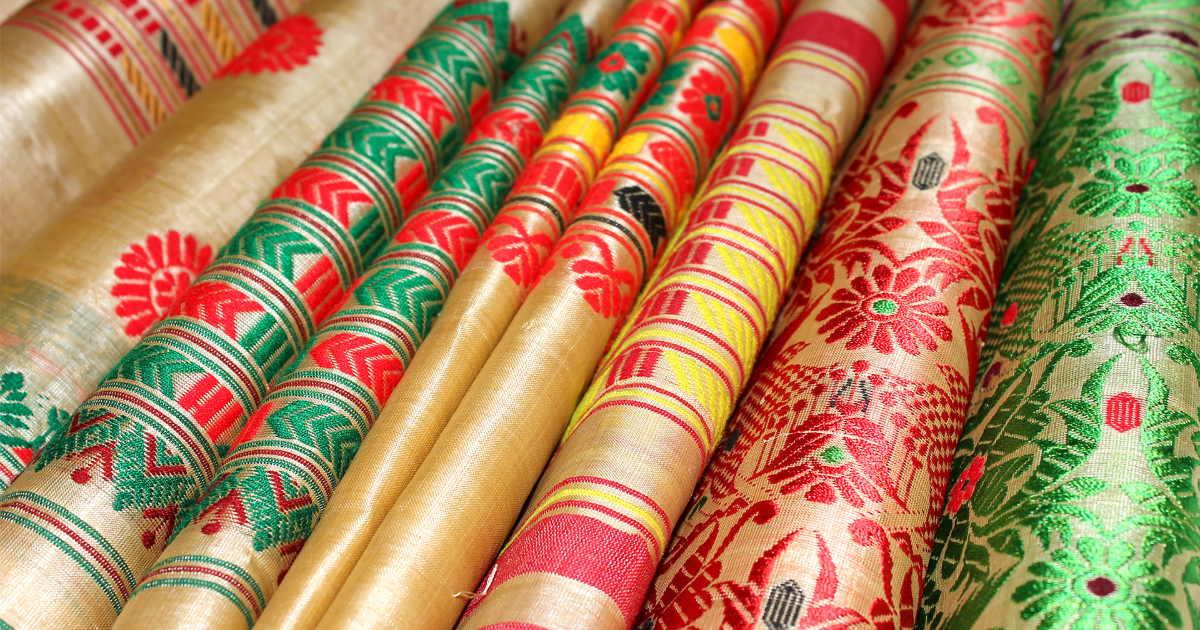
Assam is the only Indian state where Muga, Pat and Eri are reared and woven together, each producing cloth with a distinct colour, weight and texture.
What is Muga silk?
Muga silk is a wild silk produced only in Assam from the cocoons of the Antheraea assamensis moth. It is among the costliest silks made in India and is recognised by its natural gold colour. Unusually among silks, Muga gains lustre with each wash rather than losing it.
Where does Muga silk come from?
Muga silk comes from the upper Assam districts of Dhakuakhana, Lakhimpur, Sivasagar and Jorhat, where the host trees grow in commercial quantities. Rearing happens in the open, with silkworms placed directly on the leaves of standing som and soalu trees rather than in enclosed sheds. Small family-run units handle the rearing and reeling before passing the cocoons on to weavers concentrated around Sualkuchi, the principal silk-weaving town in the state.
The rearing year is divided into five cropping seasons, of which the Katia crop from mid-October carries the most commercial weight. A single cycle from egg to cocoon takes 30 to 40 days, and a mature som tree can support several hundred silkworms at a time. Most of the labour is done by women in households that also keep tea or paddy, so silk remains alongside other sources of income rather than standing as the only one.
Why is Muga silk naturally golden?
The golden colour comes from the diet of the Antheraea assamensis larva, which feeds almost exclusively on the leaves of the som tree and, to a lesser extent, the soalu. Pigments and tannins from these leaves pass into the sericin, the natural protein gum that coats the cocoon thread, so the silk is gold in its raw state and needs no dyeing. The exact shade varies slightly depending on the host tree and the season the cocoon was spun.
Because the colour comes from the fibre itself rather than a surface dye, it does not wash out. The sericin layer also gives Muga its characteristic shimmer, and traditional weavers rarely bleach the yarn for that reason. Older pieces sometimes darken slightly with age, and heirloom Muga is valued for the deeper tone it develops over decades of use.
What makes Muga silk rare and valuable?
Muga is rare because the silkworm cannot be reared outside Assam in commercial quantities, and even within the state, output is limited by the availability of host trees. Annual production stays between 200 and 260 tonnes, a fraction of India's total silk output of over 38,000 tonnes. A Geographical Indication tag granted in 2007 restricts the use of the Muga name to silk reared and woven within Assam.
Production is under pressure from deforestation, climate change and competition from small tea growers for the same land. Rising temperatures in upper Assam have already forced rearers to push the Katia crop back by ten to fifteen days to protect the silkworms. A traditional Muga mekhela chador, the two-piece garment worn by Assamese women, can take several months to weave and is often passed down between generations, so demand remains high even when supply struggles to grow.
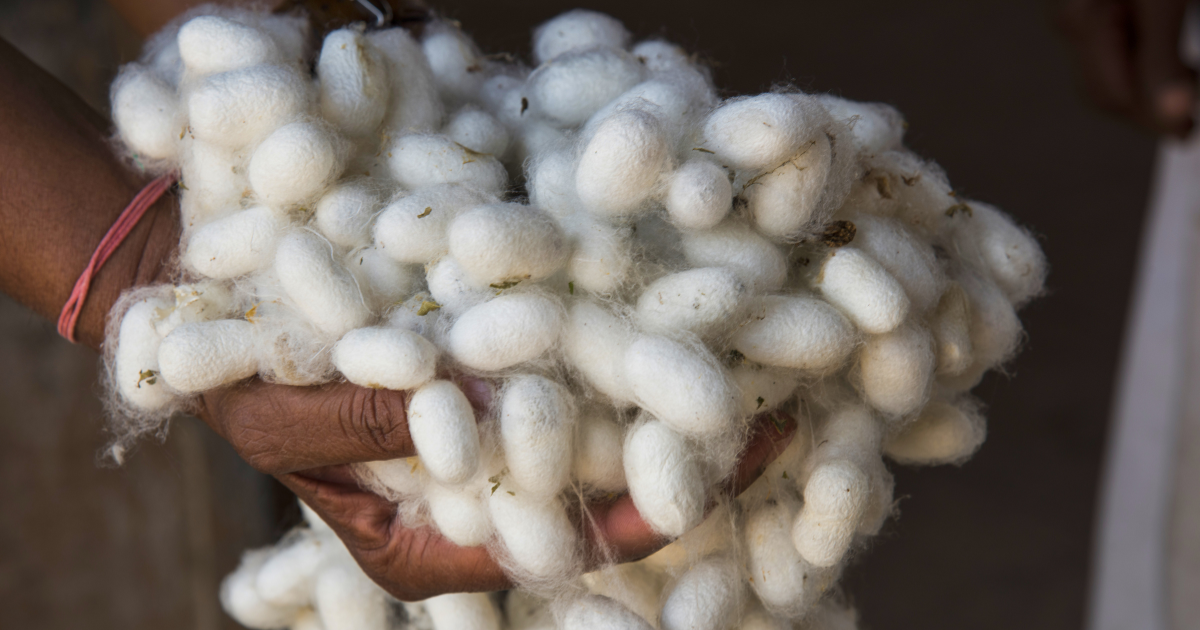
Muga cocoons are harvested by hand and passed to weavers in Sualkuchi, where the thread is reeled and woven into finished cloth.
What is Pat silk?
Pat silk is the mulberry silk produced in Assam from the Bombyx mori silkworm. It is the white silk of the region and the everyday counterpart to the more ceremonial Muga. Pat is finer and brighter than Muga, though it lacks the durability that makes Muga so valued for formal wear.
How is Pat silk different from Muga silk?
Pat is finer, lighter and produced in greater quantity than Muga, though it is less durable and less expensive. The Bombyx mori silkworm is semi-domesticated and reared indoors on cut mulberry leaves, unlike the Muga silkworm which feeds outdoors on standing trees. Because Pat thread is reeled from intact cocoons in continuous filaments, the finished fabric has a smoother surface and higher sheen than Muga.
Yield per cocoon also differs sharply between the two. A Bombyx mori cocoon gives a continuous filament that can reach over a thousand metres, while Muga cocoons yield shorter, less consistent threads. A Pat sari therefore takes weeks to weave rather than months, and a finished Pat piece typically costs a third to half the price of a comparable Muga piece. Pat is also easier to dye than Muga, and the fibre has been picked up widely in fashion textiles outside Assam.
Why is Pat silk usually white or off-white?
Pat silk is white or off-white because the Bombyx mori cocoon produces a pale, near-colourless sericin, and the mulberry diet introduces none of the pigments that turn Muga gold. The undyed thread lies somewhere between cream and ivory depending on the strain of silkworm. Most Pat is dyed after weaving, with red and black the traditional choices for festival wear.
Older Pat dyes were drawn from lac, indigo, turmeric and local barks, though most contemporary production uses chemical dyes for consistency. The natural cream tone is often left undyed for bridal pieces, where it is paired with Muga in formal Assamese dress. Red borders and motifs in zari, the metallic thread used in Indian embroidery, are the most common decorative finish on ceremonial pieces.
Why is Pat silk used in traditional Assamese clothing?
Pat silk is used in everyday and semi-formal Assamese dress because it is more affordable than Muga while still carrying the prestige of locally reared silk. Pat mekhela chador appears at weddings, religious gatherings and Bihu, the Assamese new year and harvest festival, often finished with embroidered borders. The mekhela chador consists of two pieces, a skirt called the mekhela wrapped at the waist and a long upper cloth called the chador draped over the shoulder.
Pat suits this garment because it drapes cleanly and holds embroidery without distorting the cloth. Sualkuchi weavers produce both Pat and Muga mekhela chador, and many Assamese households keep one of each, the Pat for regular wear and the Muga for weddings and the most significant family events. Beyond the mekhela chador, Pat is also used for kurtas, shirts and stoles, both within Assam and across the wider Indian designer market that values its fine weight and high shine.
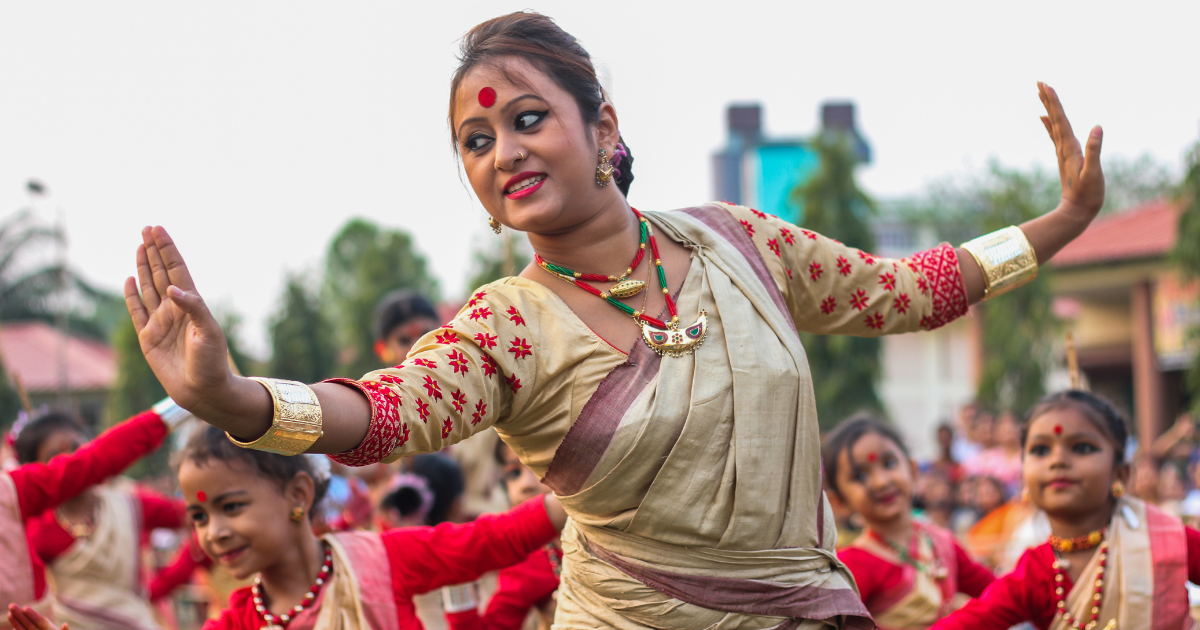
Pat silk mekhela chador are worn at Bihu across Assam, with the cream ground and red motifs the most common combination for festival dress.
What is Eri silk?
Eri silk is a hand-spun silk produced from the cocoons of the Samia ricini moth, which feeds on castor leaves. The moth is allowed to emerge naturally before the cocoon is processed, and the broken cocoon is then hand- spun into yarn in short lengths.
Why is Eri silk called peace silk?
Eri silk is called peace silk, or ahimsa silk, because the silkworm is allowed to complete its life cycle. Conventional silk-making relies on processing the cocoon while the pupa is still inside so the thread can be reeled in one continuous filament. Eri cocoons are open at one end, which lets the adult moth emerge before the cocoon is collected, and the practice aligns with the non-violent principles of Buddhist and Vaishnavite communities in the region.
The Eri tradition predates the term ahimsa silk, which was popularised in the 1990s by a sericulture officer in Andhra Pradesh as a label for ethically produced fashion silk. The Bodo, Mising, Karbi and other tribal communities of the North East have produced Eri this way for centuries, treating castor cultivation and silkworm rearing as part of household subsistence rather than ethical branding. The open structure of the cocoon is a feature of the species itself, a biological trait that long predates any modern framing of silk production.
How is Eri silk made?
Eri silk is made by hand-spinning short fibres from broken cocoons rather than reeling a single continuous filament. The cocoons are first degummed in a mild alkaline solution to remove the sericin, then opened, fluffed and spun on a takli, a hand-held drop spindle, or a charkha, the small wooden spinning wheel familiar from the Indian independence movement. The yarn that results is closer to wool in texture, and it is woven on simple frame looms in homes across Bodoland, the Karbi Hills, Meghalaya, Manipur and Nagaland.
India produces around 7,000 tonnes of Eri silk annually, far more than the 260 tonnes of Muga, and the North East accounts for roughly 98 per cent of this output. Assam leads production at close to 38 per cent, followed by Manipur at around 30 per cent, with Meghalaya and Nagaland accounting for most of the remainder. Most of the spinning and weaving is done by women in tribal households, who combine Eri work with farming and other domestic tasks rather than treating it as a full-time occupation.
What makes Eri silk different from other types of Indian silk?
Eri silk is heavier, warmer and more matte than Muga or Pat, with a hand closer to fine wool than to conventional silk. It absorbs dye well and is most often woven into shawls, stoles and winter wraps rather than formal saris or mekhela chador. Producers now also blend Eri with cotton or wool, and these mixed yarns have broadened its use into knitwear, upholstery and contemporary fashion.
The fibre has thermal properties the other two silks lack. Eri keeps warmth in winter and stays breathable in summer, which suits the climate of upper Assam and the surrounding hill states. International interest in the yarn has grown over the past decade, particularly among European and Japanese designers working in sustainable knitwear and accessories. Indian designers have also begun pairing Eri with handwoven cotton for jackets, stoles and resort-wear pieces aimed at a wider domestic market.
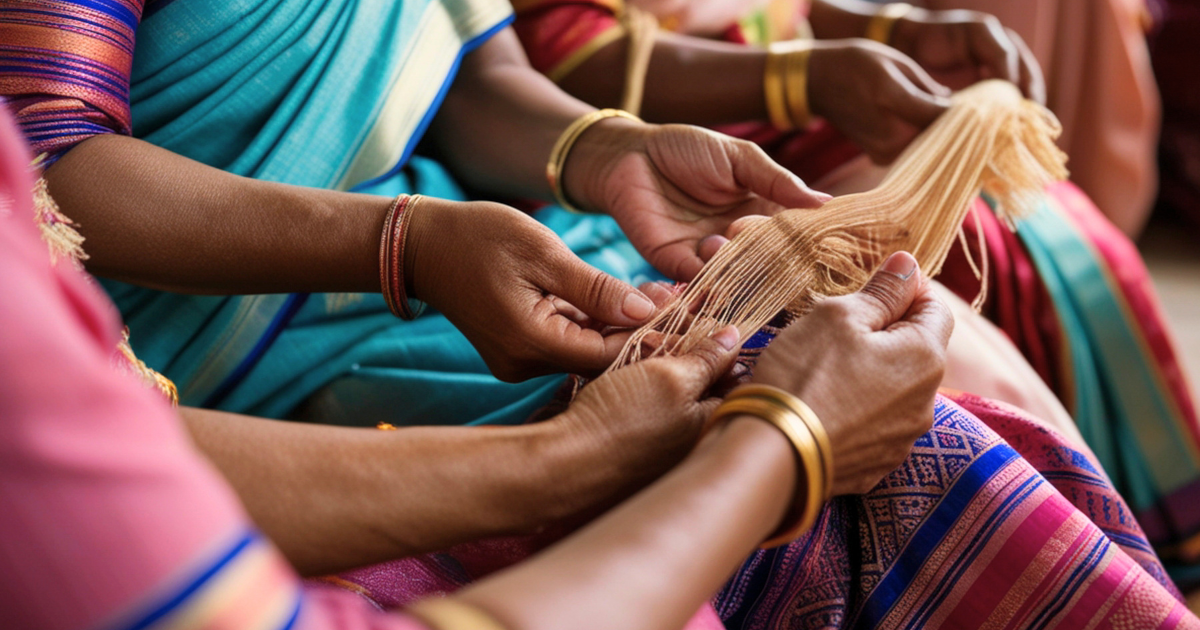
Eri silk production across the North East is largely carried out by women in tribal households, combined with farming and other domestic work.
Where can travellers see silk weaving in North East India?
Travellers can see silk weaving across several centres in Assam, with Sualkuchi, the upper Brahmaputra Valley, Majuli and Guwahati offering the most accessible visits on most India textile tours. Each location covers a different stage of the silk process, some focused on rearing and reeling, others on weaving, and others on retail. Most workshops welcome visitors during working hours, though visits are best arranged in advance through an operator familiar with the artisan communities.
Sualkuchi
Sualkuchi sits about 35km west of Guwahati on the north bank of the Brahmaputra and is the principal weaving town for both Muga and Pat silk. Almost every household has at least one handloom, and the sound of weaving carries through the lanes from morning until late afternoon. Visitors can watch weavers at work, see how Muga, Pat and silk-cotton blends differ on the loom, and buy directly from weaving cooperatives.
The village was established as a weaving centre in the 11th century by King Dharma Pala, who brought twenty-six weaver families from Tantikuchi in Barpeta district to settle the craft. The British later called it the Manchester of Assam in recognition of the scale of its handloom industry. Around 25,000 looms now operate within the village, producing roughly six million metres of silk cloth a year, and the streets are lined with workshops and small showrooms.
Brahmaputra Valley
The upper Brahmaputra Valley, including the districts of Jorhat, Sivasagar and Lakhimpur, is where most Muga rearing takes place. Travellers staying at tea estate bungalows in this region can visit nearby villages where som and soalu plantations support open-air rearing. These visits show the earliest stage of the process, before the cocoons reach the weavers downriver.
A rearing visit at the right time of year offers a clear view of the full cycle, with newly hatched silkworms feeding on the leaves alongside fully formed cocoons hanging ready for harvest. The Katia crop in October and November is the most productive of the year and the easiest to arrange access to, though smaller crops run through much of the rest of the calendar. Several heritage tea bungalows in Jorhat and Sivasagar now build silk rearing visits into their stays, often paired with a tour of the colonial-era tea factories.
Majuli
Majuli, the river island in the middle of the Brahmaputra, has its own weaving traditions tied to the Mising tribal community and the satras, Vaishnavite monastic villages founded in the 16th century. Mising women weave on backstrap and frame looms in their homes, producing Eri and cotton textiles for daily use rather than commercial sale. A visit to Majuli combines silk weaving with the island's distinct mask-making and dance traditions.
The satras were established by Srimanta Sankardeva, the 16th-century reformer of Assamese Vaishnavism, the devotional Hindu tradition centred on Vishnu, and they remain active centres of religious and cultural life. Twenty-two satras still operate on the island today, and several are open to visitors and run dance and craft demonstrations. The island itself is under threat from Brahmaputra erosion, which has steadily reduced its area over the past century, so a visit now offers a sense of both the weaving tradition and the geographic pressures bearing on it.
Guwahati
Guwahati is the practical base for textile travellers, with state emporia, private boutiques and the Assam Government Silk Showroom all stocking certified Muga, Pat and Eri. The Assam State Museum holds historic examples of Assamese weaving, and the city's markets sell raw yarn alongside finished cloth. For travellers short on time, Guwahati offers the widest range of silks in one place without the need to travel further.
The Pan Bazaar and Fancy Bazaar neighbourhoods hold most of the older silk retailers, while newer designer boutiques sit in the Zoo Road and GS Road areas. Artfed and Pragjyotika, the Assam government cooperative outlets, stock pieces with verified provenance and Silk Mark certification. Guwahati also pairs well with a visit to the Kamakhya temple on Nilachal Hill, which sits within the city limits and is one of India's most important pilgrimage sites in the Shakta tradition, the strand of Hindu worship centred on the goddess.
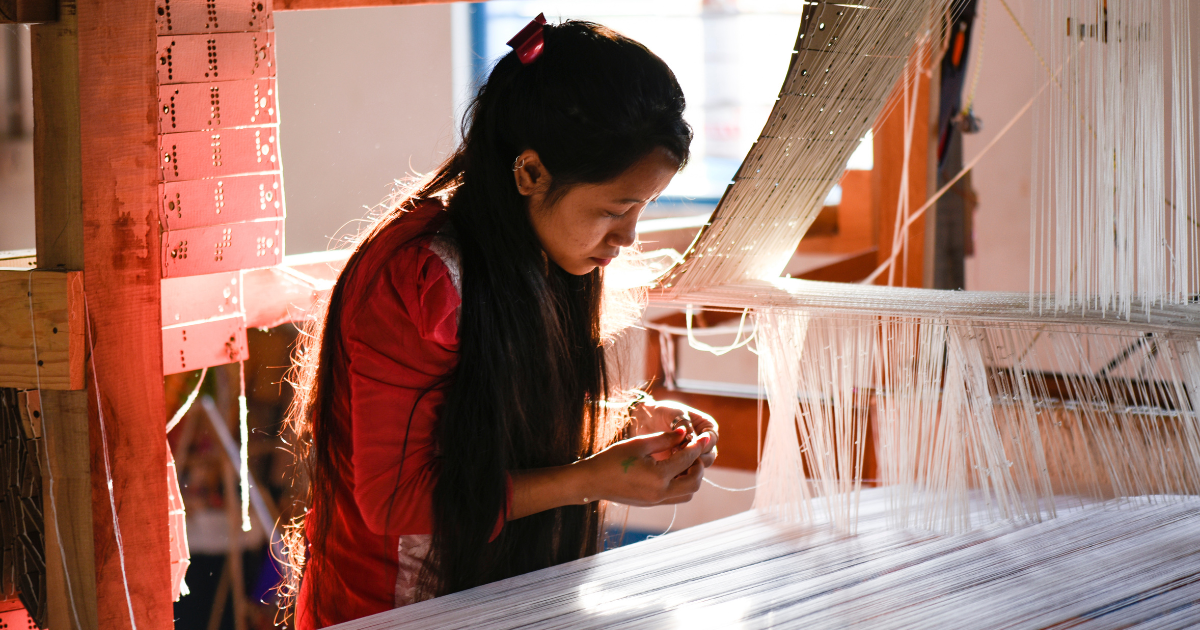
Silk weaving remains a household industry across Assam, with handlooms operating in workshops and homes throughout the Brahmaputra Valley.
What travellers should know when buying silks of North East India
Buying high quality silk in North East India requires research and preparation. Prices vary widely between authentic handwoven cloth and machine-made imitations, and the differences are not always obvious to an untrained eye.
How to recognise authentic Muga, Pat and Eri silk
Authentic Muga has a natural golden tone that is uneven and slightly irregular, never the uniform yellow of dyed cloth. Genuine Pat feels smooth and cool to the touch, with a soft sheen rather than the glassy shine of synthetic blends. Eri has a matte, slightly textured surface that resembles fine wool, and the yarn shows visible spun characteristics rather than the continuous filament of reeled silk. Pieces certified under the Silk Mark of India, the national hallmark for handwoven natural silk, or the Muga Geographical Indication tag carry official labels and traceable origin.
The traditional burn test is also a useful check when buying from less formal sources. A single thread held to a flame should burn slowly with a smell of burnt hair and leave behind a soft ash that crumbles easily. Synthetic fibres melt rather than burn, give off a chemical smell, and leave a hard plastic bead. A handwoven Muga mekhela chador with proper certification rarely sells for less than 15,000 rupees and can run considerably higher for finely worked examples, so pieces priced at a fraction of that are almost always blends or imitations.
How to buy silk directly from weavers and artisan communities
Buying directly from weavers and cooperatives keeps a larger share of the price with the artisan and gives the buyer a clearer record of where the cloth was made. Sualkuchi, Majuli and the weaving villages of Bodoland all run cooperative outlets that welcome travellers and explain the process before sale. Government-run emporia in Guwahati and other state capitals also stock certified pieces at fixed prices, so there is no need to negotiate.
A cooperative visit usually starts with a short walk through the loom shed, where weavers can be seen at different stages of work. Prices are fixed by the cooperative rather than negotiated with individual sellers, so the bargaining that some travellers find uncomfortable does not arise. Many cooperatives also ship internationally, and travellers continuing to other parts of India can have heavier pieces such as Muga mekhela chador or Eri shawls sent on rather than carried.
How to choose the right silk for clothing, gifts and everyday use
Muga is the most practical choice for occasional formal wear, as it grows softer and more lustrous with each wash and lasts for decades. Pat suits lighter saris, dupattas and shirts where drape and shine matter more than durability. Eri works best for daily wear, particularly shawls, stoles and winter wraps, and it travels well as a gift because it is warm without being heavy.
Care also varies between the three. Muga and Pat are best dry-cleaned for the first few years and can later be hand-washed in cold water, while Eri can be hand-washed from the start and gains softness over time. For travellers from cooler climates, an Eri shawl or stole is often the most practical purchase, and Muga mekhela chador and saris suit those buying for major occasions back home. India Unbound builds Sualkuchi, the upper Brahmaputra and Majuli into its northeast textiles itinerary, with arranged weaver visits and time built in to buy from source.
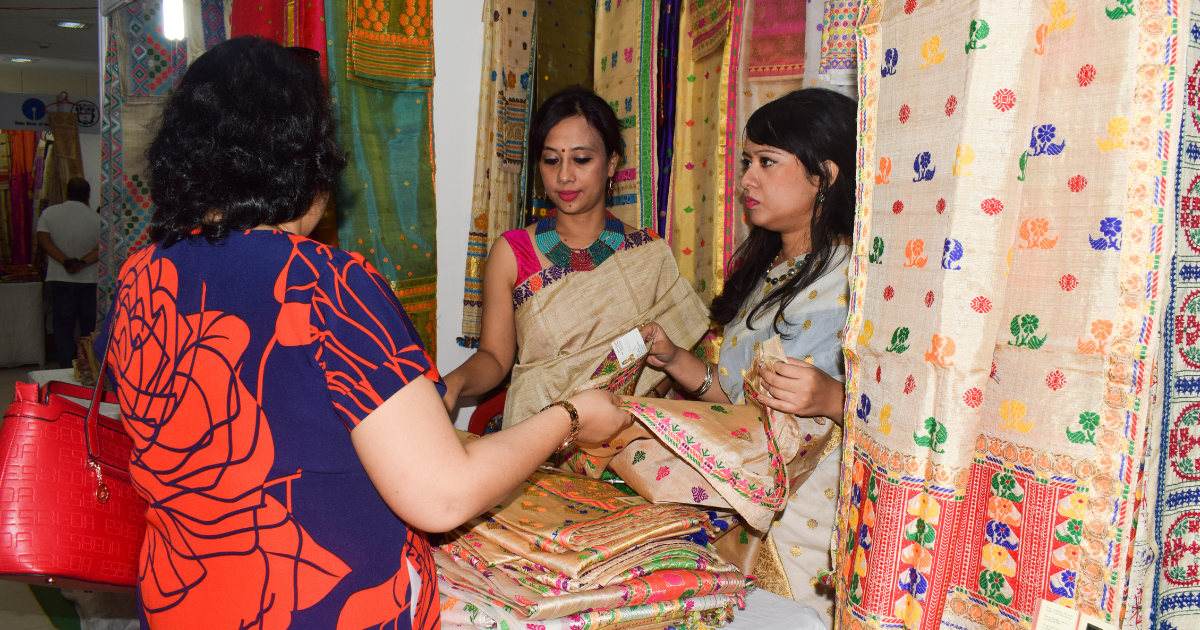
Buying silk directly from weavers and cooperatives keeps a larger share of the price with the artisan and gives the buyer a clearer record of provenance.
Travelling to North East India with India Unbound
India Unbound designs private journeys across India for travellers who want to understand the country in depth. Each itinerary is built around the traveller's interests, with carefully chosen accommodation and expert local guides on the ground. Contact our team to plan a bespoke itinerary built around the silks of North East India, or to combine textile interests with wildlife, tea or a wider tour of Assam and the neighbouring states.