
The Significance Of The Shanti Stupa In Leh
Leh sits at around 3,500m in the high desert of Ladakh, part of the far north India Himalaya, where the Indus Valley cuts between the region and Zanskar ranges. The town has been a Buddhist centre for more than a thousand years, with monasteries at Hemis, Thiksey, Lamayuru and Spituk forming part of a wider monastic network across the region. Older religious architecture in this part of the western Himalaya consists mainly of whitewashed chortens, fortified gompas and long prayer walls built into the hillsides above villages and trade routes.
The Shanti Stupa is a more recent addition to the Buddhist buildings in Ladakh, and to a different architectural tradition. Completed in 1991 on Chanspa Hill above the western edge of Leh, it was built jointly by Japanese and Ladakhi Buddhists as part of the post-war peace pagoda movement. Its hilltop position and its symbolism as a Japanese-led peace pagoda built on Ladakhi Buddhist ground have made it one of the most visited religious sites in India
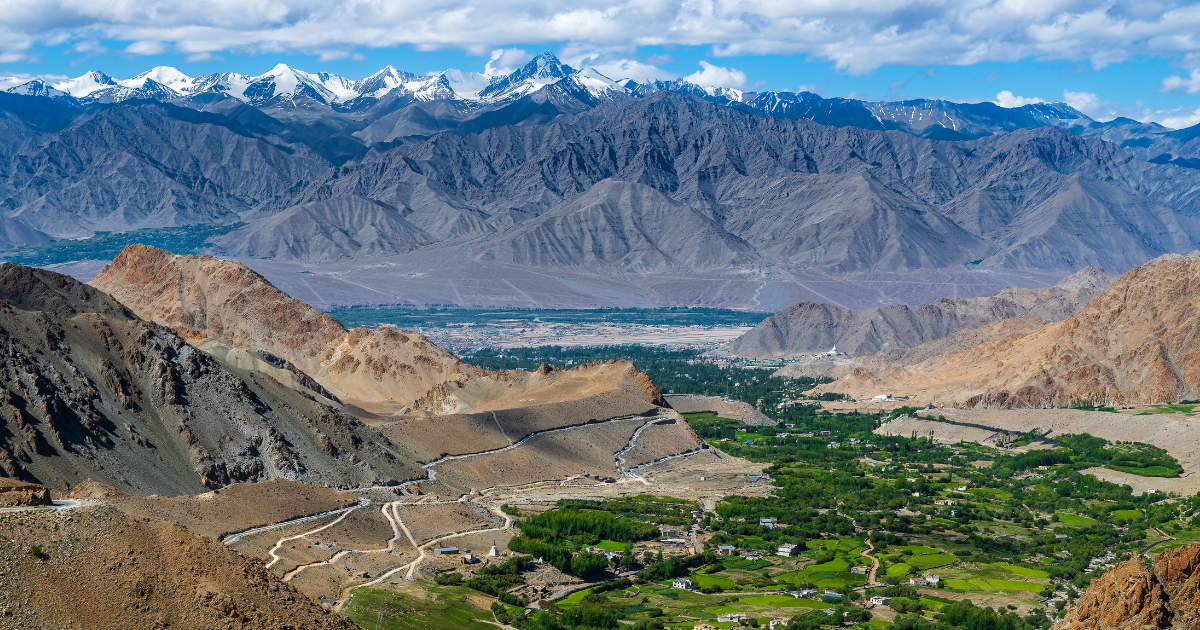
Leh sits in Ladakh’s high desert, surrounded by mountain ranges and the wider Indus Valley.
What is the Shanti Stupa in Leh?
The Shanti Stupa is a white-domed Buddhist stupa on Chanspa hill, on the western edge of Leh in the Indian union territory of Ladakh. Construction began in 1983 and was completed in 1991, when the structure was inaugurated by the 14th Dalai Lama. At 3,609m above sea level, it overlooks roughly 200m on top of Leh town and is reached either by a flight of more than 500 steps up from Changspa village or by a sealed road that climbs the same hillside.
The site functions as both an active religious building and one of the most visited viewpoints in Leh. Monks from the Mahabodhi International Meditation Centre in Leh hold daily prayers at the stupa, and the grounds fill with local worshippers during major Buddhist festivals.
What does Shanti Stupa mean?
The word shanti is Sanskrit for peace, and the term appears throughout Hindu and Buddhist liturgy, most often chanted three times at the close of prayers. A stupa is one of the oldest forms of Buddhist architecture, originally a burial mound built to house relics of the Buddha or of senior monks. The combination Shanti Stupa therefore translates directly as peace stupa and reflects the building's purpose as part of a global Buddhist peace movement.
The name also signals the influence of its Japanese builders. Stupas erected by the Nipponzan Myohoji order across India, Nepal and other countries are generally called peace pagodas in English, and the Leh structure is referred to interchangeably as the Shanti Stupa or the Ladakh Peace Pagoda in local and Japanese sources.
Where is the Shanti Stupa located in Leh?
The stupa stands on a ridge above Changspa, a residential neighbourhood at the western end of Leh known for its guesthouses, small cafes and the older Changspa Stupa nearby. From the main bazaar in Leh, the hill is around 5km by the sealed road that loops around its base, or roughly 2km on foot if approached directly up the steps from Changspa lane.
The position gives the stupa an uninterrupted view east across the rooftops of Leh town to Leh Palace and Namgyal Tsemo Gompa, and south across the Indus Valley to the Stok range, where Stok Kangri rises to 6,153m. On clear days the line of snow peaks is visible from before sunrise until well after the town below has fallen into shadow.
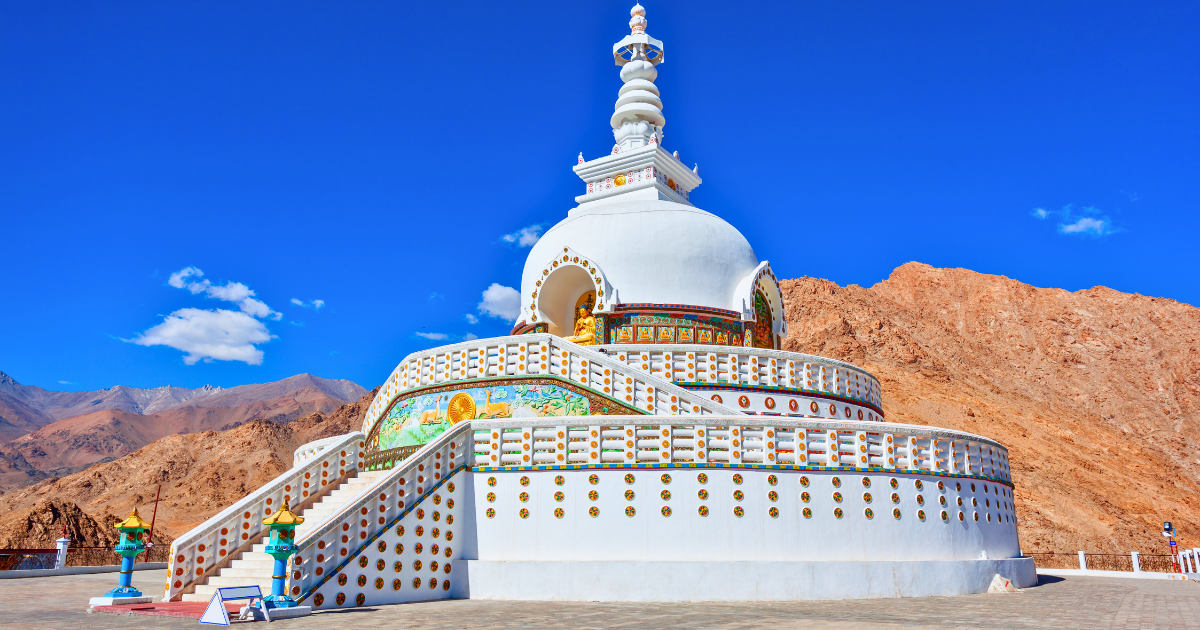
The Shanti Stupa rises above Leh as one of Ladakh’s most recognisable Buddhist landmarks.
The history of the Shanti Stupa
The Shanti Stupa came together through a partnership between a Japanese Buddhist order with a global peace mission and the Ladakhi Buddhist community that hosted the project. Its construction ran across most of the 1980s, with funding, labour and land contributed by both sides.
Who built the Shanti Stupa?
The Shanti Stupa was built by the Japanese Buddhist order Nipponzan Myohoji in partnership with the Ladakhi Buddhist community. Nipponzan Myohoji is a Nichiren order founded in 1917 by the monk Nichidatsu Fujii, who had met Gandhi at Wardha in 1933 and adopted a non-violent practice in line with Gandhian principles. After the atomic bombings of Hiroshima and Nagasaki in 1945, the movement began building peace pagodas in Japan and later in countries across Asia, Europe and North America.
On the Ladakhi side, the project was supported by the regional Buddhist community and by the Indian government, which provided the land on the ridge above Changspa. Local monks and lay volunteers worked alongside Japanese builders for much of the construction period, contributing labour through the short building seasons and helping to move materials up the hillside. The finished structure is administered today through Buddhist institutions based in Leh, including the Mahabodhi International Meditation Centre, which manages the daily ritual life of the site.
When was the Shanti Stupa built?
Work on the Shanti Stupa began in 1983 and was completed in 1991, with the inauguration held in August of that year and the 14th Dalai Lama presiding. The ceremony included the enshrinement of relics of the Buddha inside the lower tier of the structure, which the Dalai Lama provided personally. From the inauguration onwards, the completed building was handed over to the Buddhist community in Leh and has remained an active site of worship since.
The eight-year build was slowed by the difficulties of working at altitude and by the short Ladakhi season between thaw and snowfall, which leaves only a few months each year suitable for masonry and concrete work. Materials had to be brought up to a hilltop site accessible by a single road, and much of the labour was done by hand. The pace was also constrained by the project's funding model, which relied on donations from Japanese and Indian Buddhist communities rather than government or commercial backing.
Why was the Shanti Stupa built in Leh?
The choice of Leh was both practical and symbolic. Ladakh had remained one of the few regions in the Himalayas where Tibetan Buddhist practice continued without significant interruption through the second half of the twentieth century, and by the 1980s the area was attracting growing interest from Buddhist communities elsewhere in Asia. The Indian government had also opened Ladakh to foreign visitors in 1974, raising the region's international profile during the period the project was being planned.
For Nipponzan Myohoji, Leh matched a pattern of placing peace pagodas at sites of religious significance across India. The order has built similar structures at Rajgir, where the Buddha is said to have taught for years on Vulture Peak, at Vaishali, and at Darjeeling in the eastern Himalayas. The Ladakh pagoda extended that line of building into the high western Himalayas, in a region with one of India's larger concentrations of Tibetan Buddhist practice.
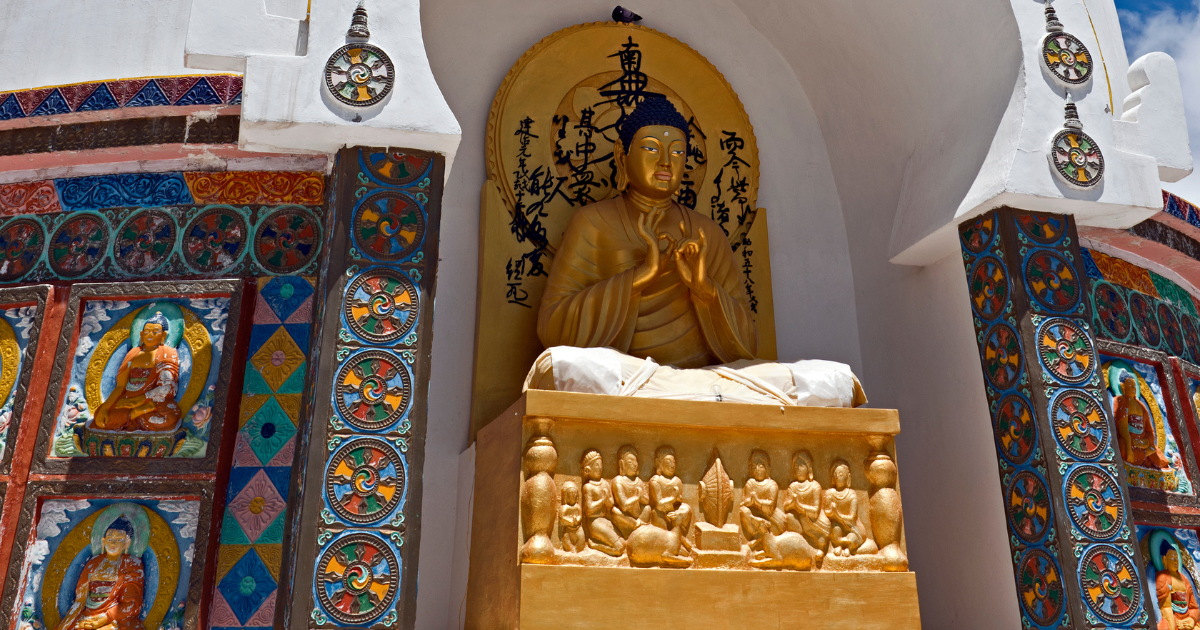
Buddha images and painted panels reflect the religious purpose of the Shanti Stupa.
The spiritual and cultural significance of the Shanti Stupa
The significance of the Shanti Stupa can be understood through its Buddhist symbolism, its role in local worship and its place within the peace pagoda movement. It carries the doctrinal symbolism of a Buddhist stupa, drawing on architectural and ritual conventions developed across more than two thousand years of Buddhist practice in South Asia. At the same time, it functions as a working part of Ladakh's living religious culture, with daily worship, festival use and a place in the routines of the surrounding community.
What does the stupa represent in Buddhism?
The rounded form of a stupa derives from early Indian burial mounds and is read in Buddhist symbolism as representing Mount Meru, the cosmic mountain at the centre of the universe in South Asian cosmology. The five structural elements of a classical stupa, namely the base, dome, harmika (square structure on top of a stupa dome), the pointed top section, and the small top ornament, are also associated with the five elements of earth, water, fire, air and space. Relics enshrined inside are understood to make the structure itself an object of veneration rather than only a marker of one.
Walking around a stupa in a clockwise direction, known as parikrama or kora, is one of the most common forms of Buddhist devotion. The act is understood as accumulating merit and bringing the practitioner closer to the qualities the relics inside represent. At the Shanti Stupa, a paved circuit around the base allows worshippers to perform this circumambulation, with prayer wheels set at intervals along the route.
How does the Shanti Stupa reflect Ladakh's Buddhist heritage?
Ladakh's older Buddhist monuments follow Tibetan building traditions brought into the region from around the eighth century and show the dominance of the Drukpa Kagyu and Gelugpa schools in local practice. The Shanti Stupa rests within this wider field but uses a Japanese architectural template instead of a Tibetan one, with a rounded dome and tiered design that look quite different from the older Ladakhi chorten form.
The site still belongs within Ladakhi Buddhist practice. Local monks lead daily worship, the relics inside are venerated in the same way as those in older stupas, and Ladakhi Buddhists treat the building as a legitimate object of devotion. Its presence demonstrates a wider exchange between Ladakhi Buddhism and other Asian Buddhist traditions that has continued through the twentieth century.
Why is the Shanti Stupa important to local culture?
For residents of Changspa and the wider Leh area, the Shanti Stupa is part of the regular religious calendar. Worshippers visit at sunrise to light butter lamps, turn the prayer wheels along the circumambulation path and recite mantras before the working day begins. The grounds fill during major Buddhist festivals including Losar, the Tibetan new year held in February or March, and Buddha Purnima, which marks the Buddha's birth, enlightenment and death. Families also use the terrace for wedding blessings, naming ceremonies for newborns and the recitation of prayers on death anniversaries.
The hill also functions as a community space at the edge of town outside formal worship. School groups from Leh visit during religious instruction days and on field trips run by the local Buddhist associations. Older residents walk up the steps in the cooler months for exercise and the view, and in the warmer months the terrace is used in the evenings by families from Changspa who come up for an hour or two after sunset. The site provides a point of connection between the newer Buddhist projects in Leh and the older monastic institutions in the surrounding Indus Valley.
Why do pilgrims and travellers visit the Shanti Stupa?
Pilgrims visit the Shanti Stupa to perform parikrama around the base, offer prayers to the seated Buddha on the upper tier and take part in the daily liturgy led by the resident monks. For Ladakhi Buddhists from villages outside Leh, the stupa is often included in a wider devotional circuit of the older monasteries in the Indus Valley, with Thiksey, Shey and Stakna usually visited on the same trip. Visiting Buddhists from elsewhere in India also come specifically to this site because of its standing within the peace pagoda network.
Travellers come for a different mix of reasons that often overlap with the religious ones. The stupa is often an early stop on introductory tours of Leh because it is easy to reach from the main bazaar and offers a clear entry point into Ladakh’s Buddhist culture. Many visitors arrive in the late afternoon to walk the terrace as the light moves across the Stok range, and others come at sunrise when the grounds are quietest and the resident monks begin the morning prayers.
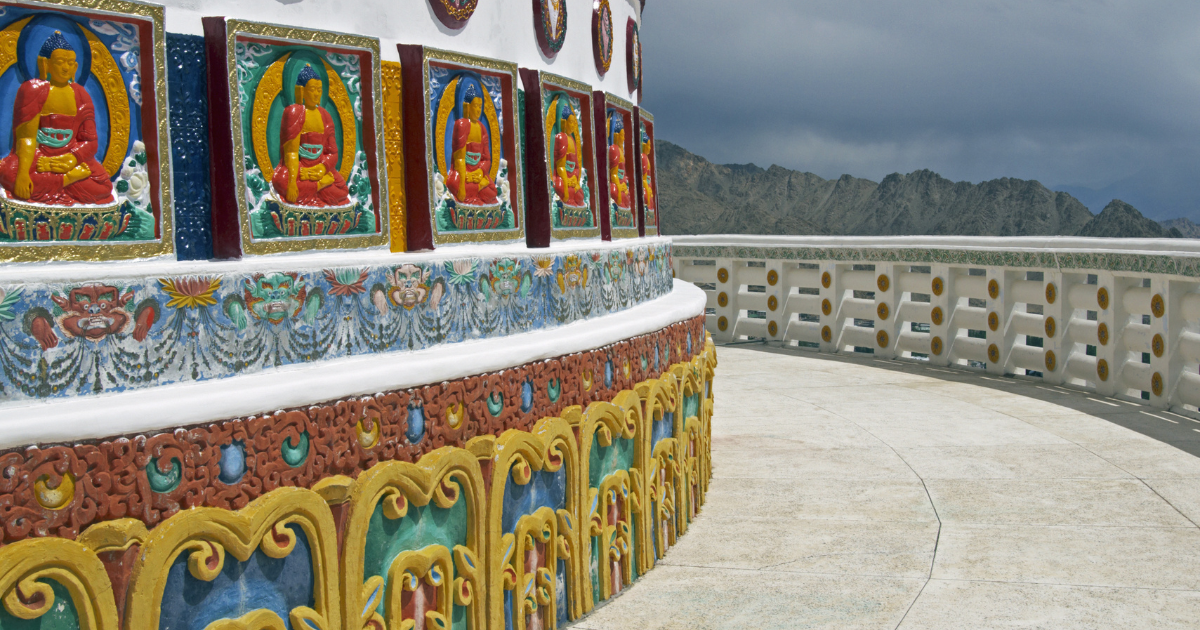
The circular path around the stupa is used for clockwise walking, prayer and quiet reflection.
Why is the Shanti Stupa famous?
The Shanti Stupa is among Ladakh’s most visited Buddhist sites and one of Leh’s most recognisable landmarks. Its fame draws on its religious standing within the Tibetan Buddhist world, its place in a global peace pagoda network, and its position on a ridge with one of the better views over the Indus Valley.
The global peace pagoda mission
The Shanti Stupa is one of around 80 peace pagodas built worldwide by Nipponzan Myohoji since the late 1940s, with sites across Japan, India, Sri Lanka, Nepal, Europe and North America. At 3,609m it is one of the highest in the network by altitude, and among the most visited because of its accessibility from Leh and its place on most Ladakh travel itineraries. The site's profile is also raised by the volume of Japanese Buddhist pilgrims who travel specifically to visit Nipponzan Myohoji installations across South Asia.
The Buddha relics enshrined by the Dalai Lama
The Buddha relics enshrined at the base of the Shanti Stupa place it in a higher religious category than a commemorative monument, that of a dhatu chaitya, a stupa containing physical remains associated with the Buddha. This is the highest category of sacred structure in Tibetan Buddhist tradition, and pilgrims from across the Himalayan Buddhist world travel specifically to perform circumambulation and prostration at such sites. The provenance of the relics, gifted from the personal collection of the 14th Dalai Lama, also gives the building a direct association with the senior figure of contemporary Tibetan Buddhism and adds to its standing outside Ladakh.
The hilltop position above the Indus Valley
The Shanti Stupa is visible from almost every part of Leh below it, and the white dome on the ridge is one of the most photographed features of the town. The contrast between the bright structure and the brown rock of the surrounding hillsides makes it especially clear from below in mid-morning and late afternoon light. This visibility has given the building a presence in the visual identity of Leh that few other Buddhist sites in the area share, even though it is the youngest of them by some margin.
Sunrise and sunset views over the Stok range
The Shanti Stupa is a well-known place for sunset views in Leh, and its reputation as a viewpoint attracts travellers who might not otherwise climb to a Buddhist monument. Travel guides, photography blogs and Indian tourism boards regularly feature the site among recommended sunset locations in Ladakh, which in turn reinforces its fame. Many first-time visitors to Leh therefore encounter the stupa first as a viewpoint rather than as a religious building, with its devotional purpose discovered on arrival.
What time should you visit the Shanti Stupa?
The Shanti Stupa is open from around 5:00am to 9:00pm and can be visited at any point during that window. The two most rewarding times are early morning, when the grounds are quiet and morning prayers are underway, and the hour before sunset, when the Stok range catches the changing light and the terrace fills with visitors.
Can you watch the sunset at the Shanti Stupa?
Yes. Sunset is the busiest time of day at the Shanti Stupa and the time most travel itineraries are built around. The terrace begins to fill from about an hour before sunset, with a mix of Indian and international visitors arriving on foot from Changspa and by taxi from the main bazaar. Local worshippers tend to arrive earlier in the afternoon for prayers, leaving the late hour mostly to visitors.
The west-facing position of the stupa means the sun sets behind the building from the terrace's main viewpoint. The sunset itself lies to the west across the lower Ladakh range, while the stronger colour usually appears on the Stok range to the south as the higher peaks catch the last light. Photographers set up facing south instead of the western side for this reason.
What should you expect during sunset?
The light at sunset in Leh moves quickly because of the altitude and the dry air, with the colour on the Stok range running through gold, pink and a deeper red within about twenty minutes. The Indus Valley falls into shadow well before the peaks above it, which gives the view a layered quality during the final part of the sunset. The white dome of the stupa itself picks up the same colours through this period and is at its most photogenic from the terrace's southern edge.
After the sun drops behind the western ridge, the temperature falls quickly. Visitors who plan to stay for the lit dome and the evening prayers should bring a warm layer even in the summer months, when daytime temperatures in Leh can reach 25 degrees but evening temperatures drop close to single figures. The drive or walk back down the hill is straightforward but darker than expected once the light has gone.
Is sunrise or sunset better at the Shanti Stupa?
Sunrise and sunset offer different experiences, and the choice depends on what a visitor is after. Sunrise is quiet, with few other visitors on the terrace and the monks beginning the morning prayers from around 5:00am. The light comes up behind Leh town from the east, with the rising sun lighting the Stok range first and the town below later, which gives the early morning a clearer line of sight than the late afternoon.
Sunset is busier, livelier and more visually dramatic, with stronger colour on the peaks and a fuller terrace. For travellers in Leh for only a short stay, sunset is the more common choice and the easier to plan around. For those staying longer or wanting a quieter visit, sunrise is the better option and pairs well with breakfast back at Changspa afterwards.
What to know before visiting the Shanti Stupa
The Shanti Stupa is open to the public at no charge and close enough to Leh town to be reached on foot or by taxi, making it easy to include in a half-day visit. The site is still an active place of worship, and most of the practicalities of a visit follow from that.
Is there an entry fee for the Shanti Stupa?
Entry to the Shanti Stupa is free. The site is maintained by the Buddhist community in Leh through donations and support from the Mahabodhi International Meditation Centre, and there is no ticket counter or formal charge at the entrance. A donation box sits inside the lower chamber for visitors who wish to contribute, with proceeds going towards the upkeep of the building and the work of the resident monks.
Reaching the site does involve a small cost for most visitors. A return taxi from Leh main bazaar to the stupa runs at around 300 to 500 rupees (roughly $5 AUD to $8 AUD) depending on waiting time. Visitors who walk up the steps from Changspa pay nothing beyond their own time and effort, with the climb taking around twenty to thirty minutes at a steady pace from the base.
What should you wear when visiting the stupa?
Modest dress is expected at the Shanti Stupa, as it is at any active Buddhist site. Shoulders and knees should be covered for both men and women, and tight or revealing clothing is not appropriate inside the lower chamber. The easiest combination is light long trousers or a long skirt worn with a t-shirt or shirt, which is the kind of dress code most visitors arriving in Leh already pack for.
The altitude and the position of the hill also matter for what to wear. Mornings and evenings at 3,609m are cold even in summer, and the wind on the exposed terrace adds to the chill, so a warm layer is useful regardless of the time of year. Sturdy shoes help with the climb up the steps from Changspa, and shoes that can be removed easily are practical given that footwear must be left at the entrance to the lower chamber.
What etiquette should visitors follow when visiting the Shanti Stupa?
Visitors should walk clockwise when circumambulating the stupa, in line with standard Buddhist practice across the Himalayan region. Photography is permitted on the terrace and around the exterior of the building, but is generally not allowed inside the lower chamber, particularly when prayers are in progress. Voices should be kept low across the site, and silence is expected inside the chamber itself.
Altitude is another practical point to consider. Most visitors arriving in Leh by air come up from sea level in a matter of hours, so the climb to the stupa is best left until the second or third day of a stay to allow for acclimatisation. The road approach is gentler on first-day visitors than the steps from Changspa, and walking pace on the terrace should be slower than at lower altitudes until the body has adjusted to the thinner air.
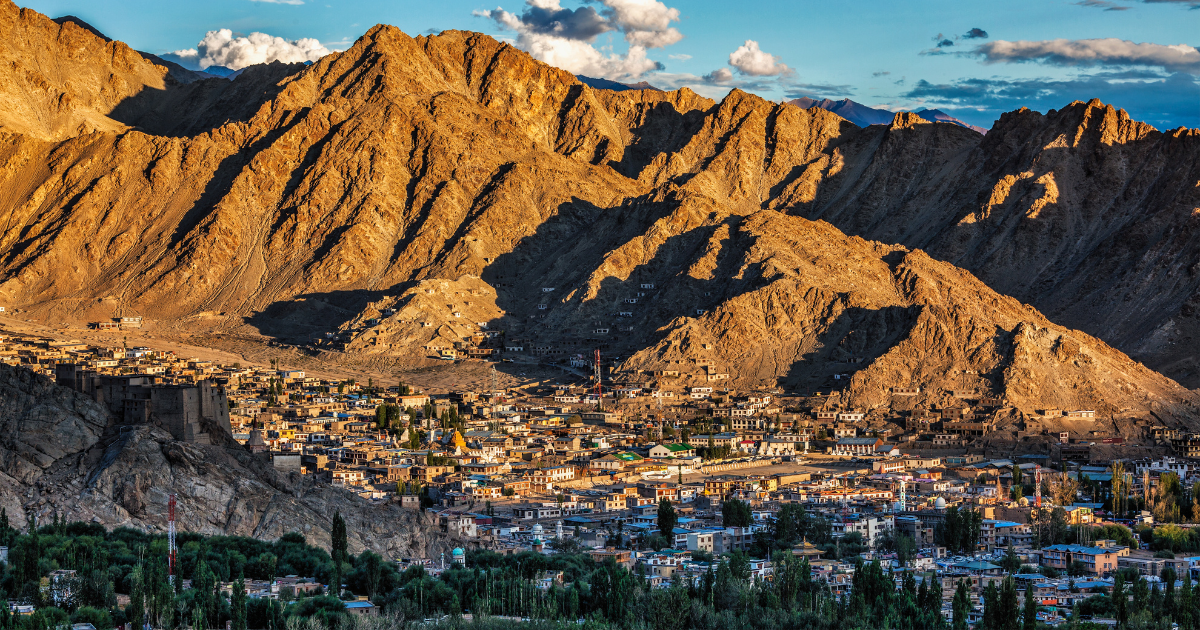
Evening light moves across Leh and the surrounding Ladakh mountains, one of the reasons visitors time their Shanti Stupa visit around sunset.
Travelling to Leh and Ladakh with India Unbound
India Unbound designs private journeys across Ladakh and the wider Himalayan region, with carefully chosen accommodation and expert local guides who know the area in depth. Our Far North and Indian Himalaya tours cover Ladakh alongside Himachal Pradesh and Uttarakhand, and can be tailored around Buddhist culture, mountain landscapes or quieter regional travel beyond Leh. To plan a Ladakh journey built around your dates, pace and interests, get in touch with our team.