
The Historical Significance Of The Qutab Minar In Delhi
Mehrauli in South Delhi is one of the city’s oldest areas, where the remains of forts, mosques and royal tombs reflect centuries of settlement. Its historic buildings recall a time when this part of Delhi was a centre of political and religious life, long before the Mughal city developed farther north. As successive rulers built beside the monuments of their predecessors, they left a concentration of buildings that helps trace these changes across different periods.
Qutab Minar stands within this setting, surrounded by mosques, tombs and gateways built under successive sultans. Its construction began in the late 12th century, during the political changes that led to the establishment of the Delhi Sultanate in North India. The tower and surrounding monuments preserve evidence of this formative period, showing how the new rulers established their authority through religious buildings and royal patronage.
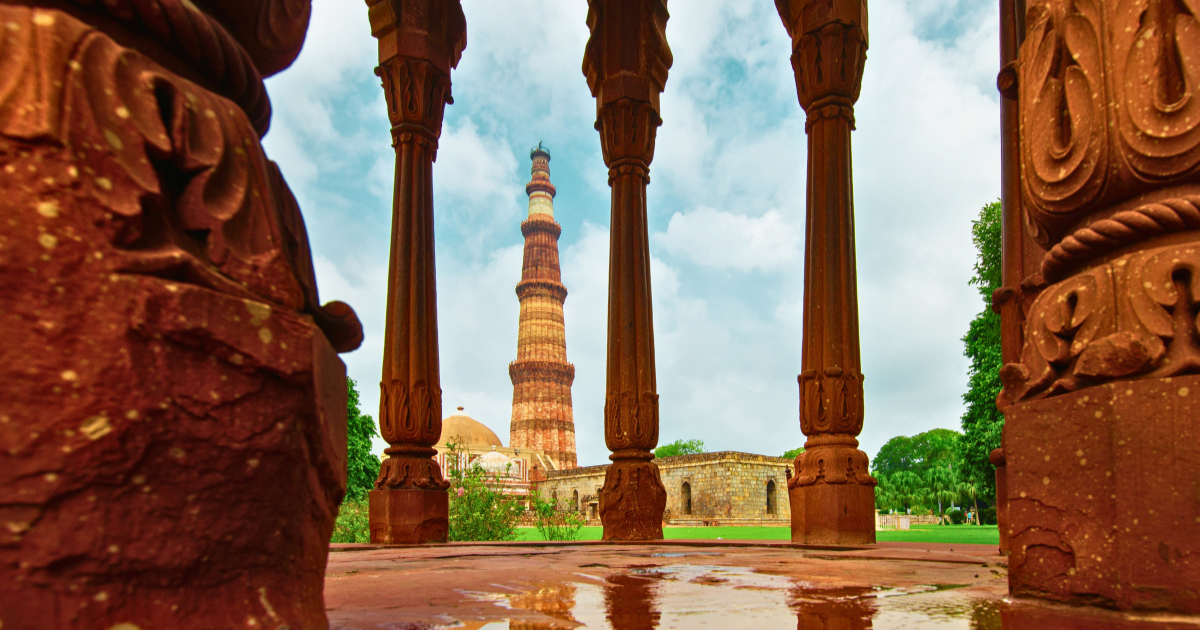
Qutab Minar forms part of a larger complex developed by Delhi’s early sultans over several generations.
Why is Qutab Minar famous?
Qutab Minar, also spelled as Qutub Minar and Qutb Minar, is famous for its height, carved stonework and importance in early Indo-Islamic architecture. Its five storeys rise above the surrounding monuments, with projecting balconies and bands of inscriptions covering the exterior. This combination of scale and detailed craftsmanship makes it a distinctive landmark among Delhi heritage sites.
Height and carved stonework
At approximately 72.5 metres, Qutab Minar rises from a base about 14.3 metres wide and narrows to roughly 2.7 metres at the top. Its five storeys are separated by projecting balconies supported on carved stone brackets. Rounded and angular grooves alternate along parts of the shaft, giving the exterior a more varied surface than a plain cylindrical tower.
The materials also change with height, with red and buff sandstone in the lower storeys and marble appearing in the rebuilt upper section. Bands of inscriptions run around the tower, combining religious texts with records of construction and repairs. These details help explain how the monument developed, since its present appearance reflects work carried out under several rulers.
A landmark of the early Delhi Sultanate
Construction began under Qutb-ud-din Aibak in 1199, while he was governing territories in North India on behalf of Muhammad of Ghor. Aibak later became an independent ruler, establishing the Delhi Sultanate in 1206. The tower therefore belongs to a period when conquest was followed by the creation of a new state, whose rulers commissioned substantial religious buildings in Delhi.
Iltutmish continued the tower and enlarged the adjoining Quwwat-ul-Islam Mosque, developing the site as a centre of congregational worship. Later, Alauddin Khalji commissioned another minaret intended to exceed Qutab Minar in scale, although only its first storey was built. The unfinished Alai Minar remains within the complex, showing how the earlier tower became a point of comparison for another ruler’s ambitions.
UNESCO World Heritage recognition
Qutab Minar and its surrounding monuments became a UNESCO World Heritage Site in 1993 for their importance in early Indo-Islamic architecture. The recognition covers a group of buildings with different purposes, including the Quwwat-ul-Islam Mosque, the tomb of Iltutmish and the Alai Darwaza gateway. Together, they show how places of worship, royal burial chambers and ceremonial entrances developed under the Delhi sultans.
Their architectural details make these changes visible. The mosque incorporates carved columns from earlier Hindu and Jain temples, while the interior of Iltutmish’s tomb is decorated with inscriptions and geometric patterns. Alai Darwaza, added in 1311, belongs to a later phase of construction. Preserving these buildings together allows the history of the complex to be understood through the structures and stonework that survive.
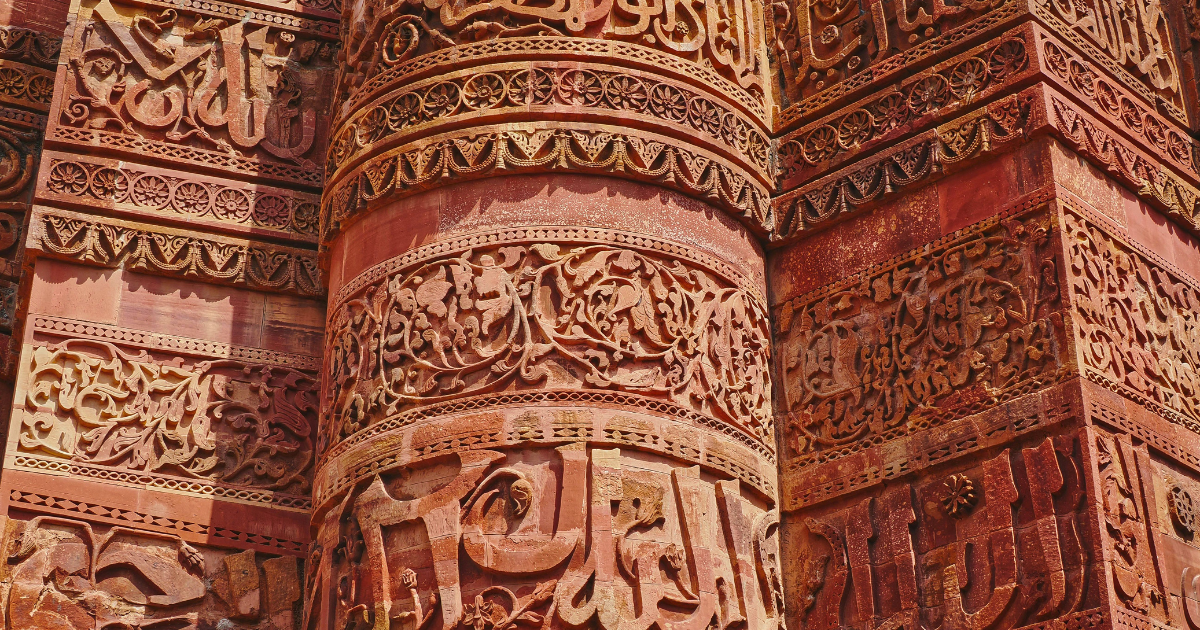
Quranic verses, passages praising rulers and records of repairs turn the tower’s surface into a written account of its religious and political history.
What is the history of Qutab Minar?
Qutab Minar’s history begins under the Ghurids, a dynasty based in what is now Afghanistan whose conquests extended into North India. Construction continued after their territories around Delhi became an independent sultanate. Later rulers repaired damage to the tower, and restoration continued under British administration in the 19th century.
Who built Qutab Minar?
Qutb-ud-din Aibak commissioned Qutab Minar while governing territories in North India on behalf of Muhammad of Ghor. Having once been enslaved, he rose through military service to become one of Muhammad’s principal commanders. His building projects in Delhi included the Quwwat-ul-Islam Mosque and the first storey of the tower beside it.
Aibak’s son-in-law Iltutmish continued the project, adding three storeys above the existing base and bringing the early tower to four levels. He also enlarged the adjoining mosque, developing both buildings within the same religious complex. His contribution accounts for much of the tower’s original height.
When was Qutab Minar built?
Construction began in 1199, when Delhi was still under Ghurid control. Muhammad of Ghor’s death in 1206 changed the political situation, allowing Aibak to establish his own rule. The tower’s foundation predates the Delhi Sultanate, even though much of its construction took place under the sultans who governed the new state.
After Aibak died in 1210, a brief reign under Aram Shah preceded Iltutmish’s accession in 1211. The next major phase of construction belongs to Iltutmish’s reign, which lasted until 1236. Rather than having a single completion date, the monument has an early 13th-century structure with an upper section that was substantially rebuilt in the 14th century.
Why was Qutab Minar built?
Qutab Minar was built as part of the Quwwat-ul-Islam Mosque complex, where Muslims gathered for prayer. It served as the mosque’s minaret, a tower traditionally used to announce prayer times to the surrounding community. This religious function explains its position beside the mosque and its connection to the worship that took place there.
The tower also celebrated the military victory that brought Delhi under new rule, which is why it is often described as a victory tower. Its inscriptions include religious verses and passages praising rulers, bringing both purposes into the decoration of the building. Through these inscriptions, the patrons associated their authority with the faith practised at the adjoining mosque.
How has Qutab Minar changed over time?
A lightning strike in 1368 damaged the upper part of the tower, prompting Firoz Shah Tughlaq to rebuild it. He replaced the damaged fourth storey with two smaller levels, producing the five-storey arrangement seen today. Sikandar Lodi later commissioned repairs in 1503, continuing the practice of maintaining a monument inherited from earlier dynasties.
An earthquake in 1803 caused further damage, leading to restoration supervised by Major Robert Smith under British administration. His work was completed in 1829, several centuries after the medieval repairs. The Archaeological Survey of India now maintains the complex, preserving a tower whose surviving structure records both its original construction and the interventions that followed.rose through
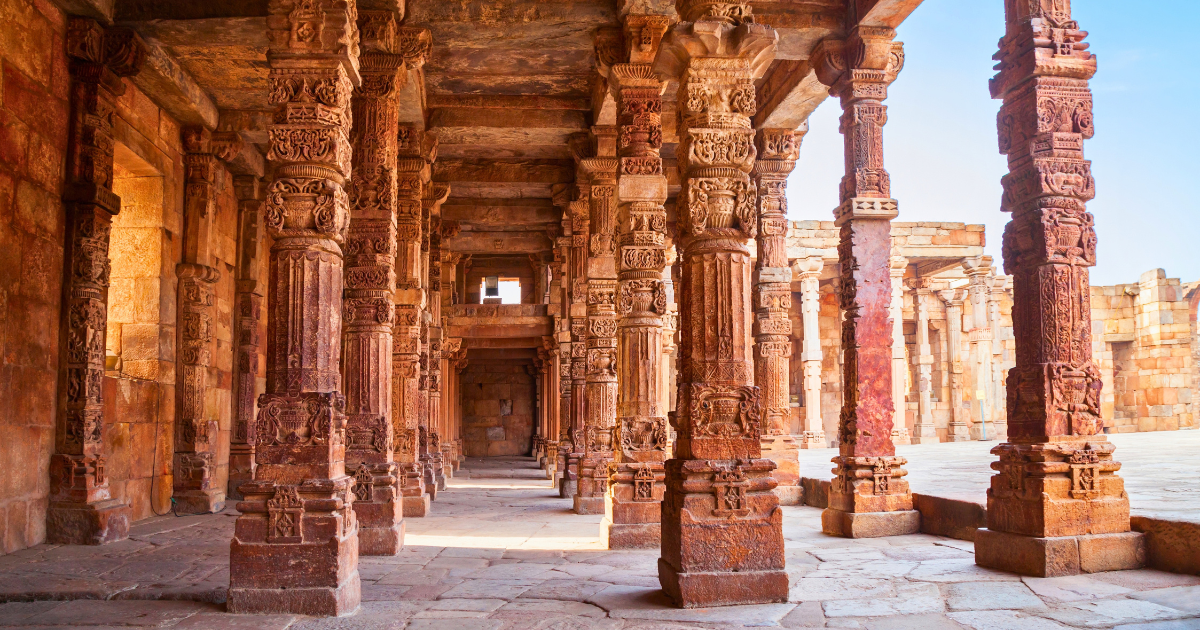
Stonework from demolished Hindu and Jain temples was incorporated into the mosque, preserving earlier craftsmanship within a new religious setting.
What other monuments are in the Qutab complex?
The Qutab complex includes the Quwwat-ul-Islam Mosque, the Iron Pillar, royal tombs and later additions such as Alai Darwaza and Alai Minar. These structures were built for different purposes and do not all belong to the same period. Exploring them alongside the tower reveals the earlier religious objects, reused building materials and successive expansions within the grounds.
Quwwat-ul-Islam Mosque
The Quwwat-ul-Islam Mosque was one of Aibak’s earliest building projects after Delhi came under Ghurid control in the 1190s. Its congregation gathered in a rectangular courtyard bordered by covered walkways supported on carved columns. A tall arched screen on the western side marked the prayer area, oriented towards Mecca.
Its construction also records the disruption that accompanied the conquest. Carved columns and other material from demolished Hindu and Jain temples were reused in the mosque, leaving earlier religious decoration visible within its covered walkways. Iltutmish and Alauddin Khalji subsequently enlarged the building, so the surviving remains combine its original construction with additions made as the Sultanate developed.
The Iron Pillar
The Iron Pillar belongs to a much earlier period than the mosque surrounding it. Dating to around the fourth century, it was created as a Hindu religious monument several centuries before the Delhi Sultanate existed. Its presence in the courtyard brings an older history into the complex, although its current position should not be mistaken for its original setting.
An inscription engraved on the pillar in Sanskrit records its dedication to Vishnu and commemorates a king named Chandra. It also refers to its erection on a hill called Vishnupada, connecting it with an earlier place of worship. Alongside this religious purpose, the pillar preserves evidence of early Indian metalworking through the production of a large iron monument that has survived into the present.
Alai Darwaza and Alai Minar
By the early 14th century, Alauddin Khalji was expanding the Quwwat-ul-Islam Mosque and its surrounding grounds. His additions included Alai Darwaza, completed in 1311 as a ceremonial entrance on the mosque’s southern side. He also began Alai Minar, a second tower intended to rise to twice the height of Qutab Minar.
Work on Alai Minar stopped following Khalji’s death in 1316, and his successors did not resume construction. Only the first storey was built, leaving the broad unfinished structure that stands north of Qutab Minar today. Its incomplete state reflects how closely this ambitious building project depended on the ruler who commissioned it.
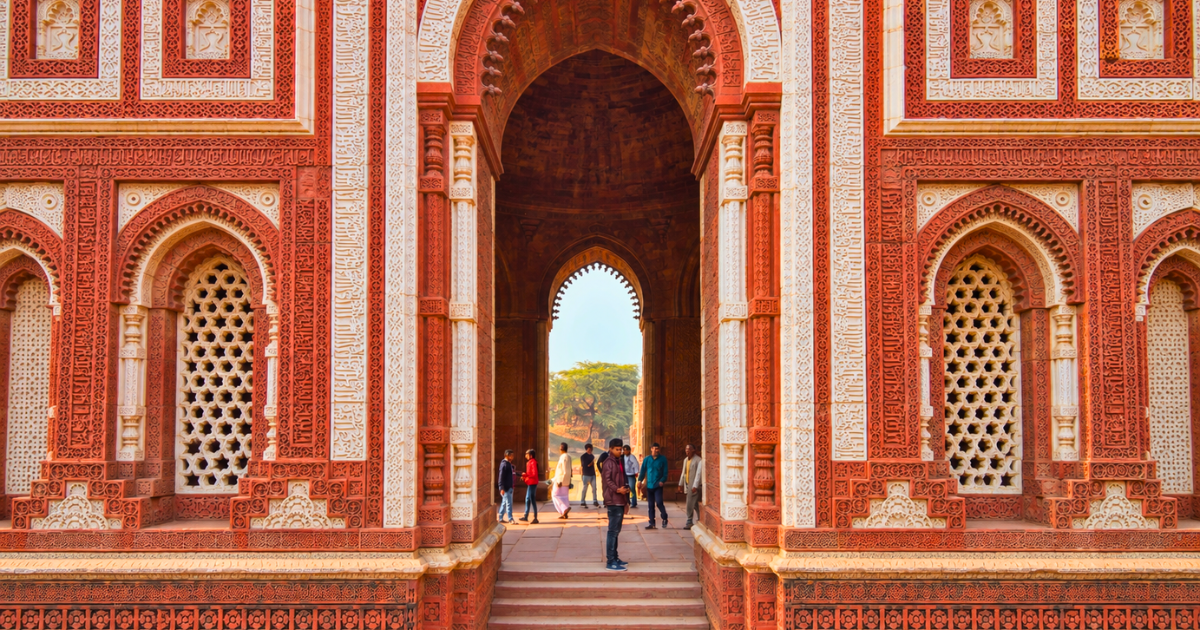
Completed in 1311 under Alauddin Khalji, Alai Darwaza formed part of his expansion of the Quwwat-ul-Islam Mosque.
What to know before visiting Qutab Minar
Qutab Minar is part of a larger archaeological complex, so a visit involves walking between several monuments rather than stopping only at the tower. Most of this exploration takes place outdoors, with time spent crossing courtyards and examining buildings from ground level. The weather, footwear and time allowed can therefore make a considerable difference to the visit.
Can visitors enter Qutab Minar and how long does a visit take?
The interior of Qutab Minar is closed to the public, so visitors cannot climb its staircase or access the balconies. The tower is viewed from the surrounding grounds, where different positions reveal its tapering shape, carved bands and changes in stonework.
Allow around one to two hours for an unhurried visit that includes the Quwwat-ul-Islam Mosque, Iron Pillar, Alai Darwaza and Alai Minar. Those interested in architectural details or photography may prefer longer, particularly when exploring with a guide. For an afternoon visit, checking the closing time helps ensure that enough time remains to explore the wider complex.
When is the best time to visit?
October to March generally offers more comfortable conditions for exploring Delhi’s outdoor monuments than the hotter months. Temperatures still vary across this period, with chilly winter mornings and warmer afternoons towards either end of the season. Winter fog can also reduce visibility, occasionally obscuring the tower’s upper levels until conditions improve.
During warmer months, visiting early helps to reduce the amount of walking in strong afternoon heat. Although some covered walkways provide shelter, moving between the monuments means spending time in the sun. Planning pauses between buildings and carrying drinking water makes a slower exploration more comfortable, particularly when stopping to examine carvings and inscriptions.
What should visitors wear and bring?
The visit involves walking and standing on stone surfaces, so comfortable shoes with a secure fit and good grip are more suitable than heels or loose footwear. Lightweight, breathable clothing works well in warm weather, with a hat and sunscreen useful in the open courtyards. During winter, a removable outer layer allows for the change between a cold start and a warmer afternoon.
Bring drinking water during the visit, especially when spending longer in the grounds. Keeping it in a small bag makes it easy to reach during breaks and leaves hands free for taking photographs. Packing lightly also reduces the amount carried while walking and standing around the grounds.
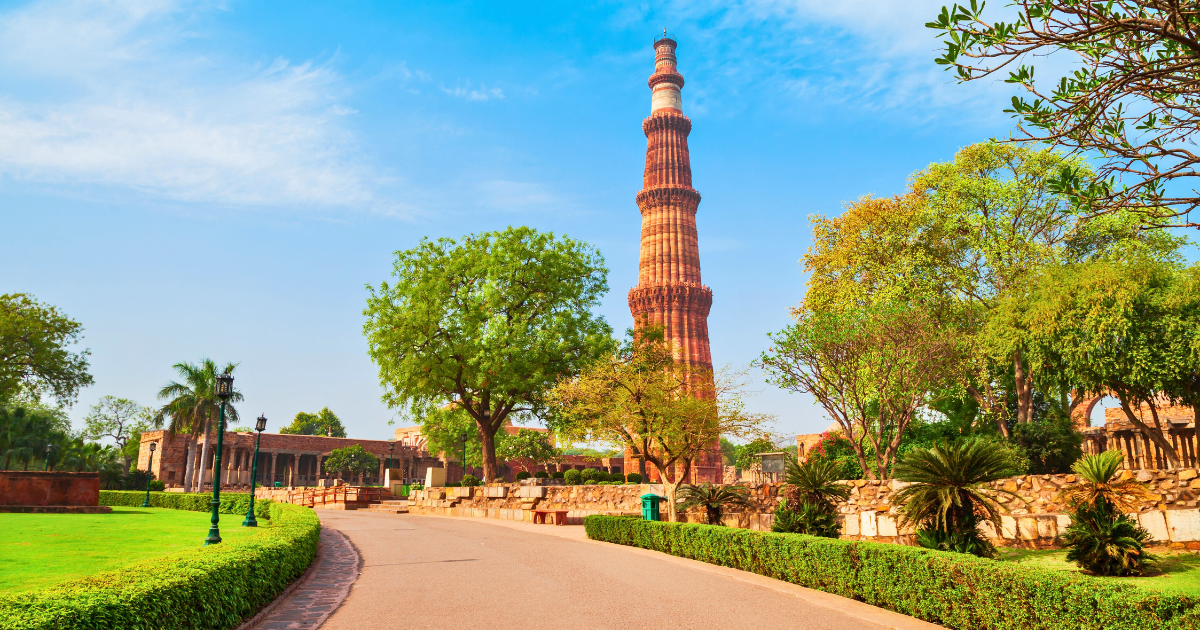
Qutab Minar rises above a complex of mosques, tombs and gateways developed under successive rulers of the Delhi Sultanate.
Visit Qutab Minar with India Unbound
India Unbound designs private journeys through Delhi and across India, with carefully chosen accommodation and expert local guides who know the destinations in depth. A visit to Qutab Minar can be included in The Story Of Indian History private tour exploring the city’s Sultanate monuments, Mughal architecture and historic neighbourhoods. To plan an India journey built around your dates, pace and interests, get in touch with our team.