
Munnar sits high in the Western Ghats of Kerala, where the land folds into steep ridges and the air stays cool through most of the year. The slopes here are covered almost entirely in tea, planted in close rows that follow the contours of the hills and shift colour with the light through the day. This is one of the highest tea-growing regions in southern India, and the plantations have given the town its character and its livelihood for well over a century.
The story of how tea came to these hills is not obvious from the road. Travellers passing through see the estates and the pickers at work, but the history behind the landscape, the machinery that once ran the factories, and the communities that grew up around the industry are easy to miss. Much of that record now sits on the Nallathanni Estate just outside the town, at the Munnar Tea Museum, which traces how the region became a centre of tea production and how the estates still flourish today.
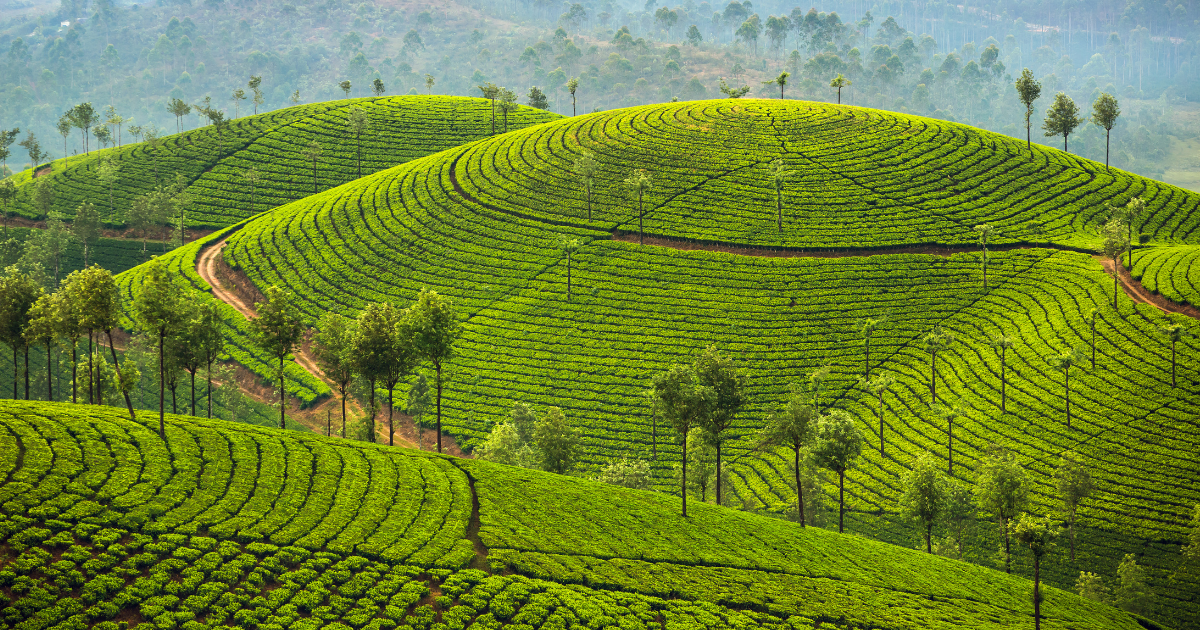
Tea has grown across the high ranges of Munnar for around 140 years.
What is the history of tea in Munnar?
Tea has only grown in Munnar for around 140 years, a short span against the age of the hills themselves. Until the mid 19th century the high ranges were dense forest, home to the Muthuvan community and largely beyond the reach of commercial interest, with no tea bushes anywhere on the slopes. The tea plantations that now cover the region took shape within a few decades, the result of a colonial enterprise that turned forested highland into one of southern India's main tea-growing areas.
How did tea arrive in the hills of Kerala?
The tea story started in 1877, when a British official named John Daniel Munro leased a large tract of the Kannan Devan Hills from the Poonjar royal family, who held the high range at the time. Munro set up a planting society two years later and began clearing the forest, though tea was not the first idea. The early planters tried coffee, cardamom and cinchona before finding that tea did far better in the cool, high air than any of them.
The first tea went into the ground in 1880, when the planter A.H. Sharp put around 50 acres under cultivation at Parvathy, on land that is now part of the Seven Mallay Estate. Munnar came to tea well after Assam and Darjeeling in the north, but its altitude gave it an advantage. The estates here sit above 1,500 metres, and that height produces a lighter high-grown leaf that sold well into the British market.
Who built and worked the Munnar tea estates?
By the turn of the century, dozens of estates had been carved out of the high ranges, and almost all of them ran on labour brought in from outside the region. Plantation work needed a large, settled workforce, so planters recruited heavily from Tamil-speaking districts to the east, and many of those who walked into the hills stayed for good.
The same pattern built estate after estate, where workers cleared the forest, planted the bushes, and laid the roads, factories and lines of housing that still organise estate life today. Sevenmallay, where A.H. Sharp planted the first tea in 1880, and Lockhart, opened a year earlier, were among the first to take shape this way, with others following across the hills.
Plucking was, and remains, skilled manual work. Pickers move along the rows taking only the top two leaves and a bud, the standard that sets the quality of the finished tea. Each estate grew into a largely self-contained world, with its own factory, settlements and daily routines, and generations of the same families have worked in them. There are now more than 50 estates in and around Munnar, spread across the hills under several different owners.
Who runs the Munnar tea estates now?
The largest holding by far is Kannan Devan Hills Plantations, which grew out of the estates Finlay Muir and Company brought together in 1895, some 33 of them, managed under the Kannan Devan Hills Produce Company from 1897. The Tata Group took the operations forward from 1964, and in 2005 the estates were restructured as Kannan Devan Hills Plantations Company, with the workers themselves holding the majority stake. This makes it one of the largest employee-owned plantation businesses of its kind in India, a model that has become a point of real pride in the region.
The other estates around Munnar each have their own story. Lockhart, one of the earliest in the region, is run by Harrisons Malayalam and welcomes visitors to its heritage factory, and established names such as AVT, Michael's and Brooke Bond work gardens across the hills. Higher still is Kolukkumalai, the highest tea estate in the world, where tea is made by traditional orthodox methods much as it was a century ago.
Among them all, it is the Kannan Devan company that established and runs the Munnar Tea Museum, on its Nullatanni Estate, keeping the museum close to the working plantations it celebrates.
What is the Munnar Tea Museum?
The Munnar Tea Museum is a small history and industry museum that records how the surrounding estates were built and how tea is made. It was the first museum of its kind in India when it opened in 2005, and it holds the machinery, photographs and everyday objects that the working plantations accumulated over more than a century. The collection runs to only a few rooms, but almost everything in it came off the estates that still surround the building.
Where is the Munnar Tea Museum located?
The museum stands on the Nallathanni Estate, a working tea estate around 2km from the centre of Munnar town, in the Idukki district of Kerala. The road passes through the plantations, so visitors arrive already inside the landscape the collection describes, high in the Western Ghats near the border with Tamil Nadu. It carries several names, which can cause some confusion. Most signs and tickets call it the Tata Tea Museum, after the company that once ran the estates, though its formal title is the Kannan Devan Hills Plantations Tea Museum, usually shortened to KDHP.
Why was the museum created?
The museum opened in 2005, the same year the estates were restructured under employee ownership, and it was set up to preserve the record of how the plantations came to be. Much of what it holds is practical equipment from the working estates: the rollers and engines from the early factories, the office furniture and typewriters from the estate bungalows, the photographs of the planters and labourers who cleared the hills. As the factories modernised, this older material would otherwise have been scrapped or dispersed. Gathering it in one place lets the museum show how Munnar changed from forest into a plantation centre within a few decades.
How is the museum connected to Munnar's tea estates?
The museum is run by Kannan Devan Hills Plantations Company, the business that owns and works the estates surrounding it, so its collection comes from operations still running nearby. The 1905 tea roller and the other early factory equipment on display were used on these hills rather than gathered from elsewhere, and the demonstration line inside follows the same processing stages the estate factories use today. Some of the exhibits reach beyond tea altogether, including a granite sundial made in 1913 and furniture from the colonial planters' bungalows, which together give a picture of estate life in the early decades. This keeps the museum tied to an industry that is still at work a short walk from the door.
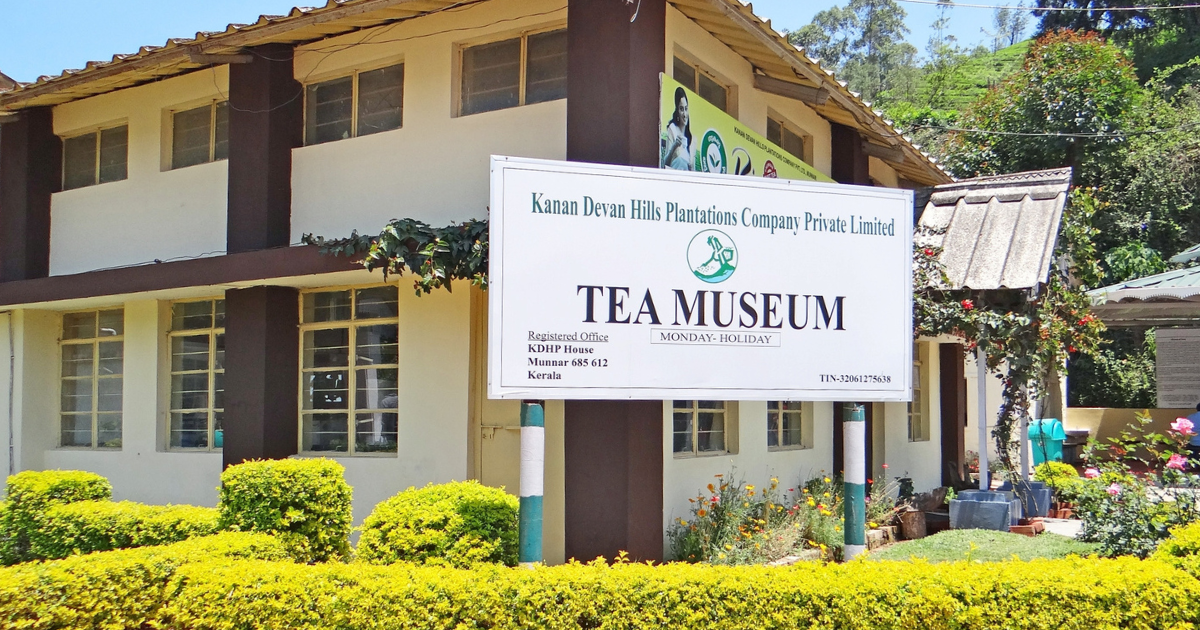
Most signs and tickets use the Tata name, though the museum's formal title is the Kannan Devan Hills Plantations Tea Museum.
What can you see at the Munnar Tea Museum?
The collection divides roughly into two parts: the machinery and objects that record how the estates were built, and the working demonstration that shows how tea is still made. A guided route runs through the display rooms before reaching the factory area, where staff explain the processing and visitors can taste the results. The displays are well labelled, and most visitors spend between one and two hours inside.
Antique tea machinery and factory equipment
The oldest working exhibit is a 1905 tea roller, the Rotorvane, used in CTC processing, or the crush-tear-curl method that produces most everyday black tea. It marks the starting point for the museum's account of how the factories developed. Nearby sits a Pelton Wheel, the water-driven turbine that powered a small generating plant on the Kanniamallay Estate in the 1920s, a reminder that the estates had to build their own electricity before any grid reached the hills. Both pieces came off working estates rather than from a general collection.
One of the more unusual items in the museum has nothing to do with tea processing at all. A rail engine wheel survives from the Kundala Valley Light Railway, a narrow-gauge line that carried tea, supplies and workers between Munnar and Top Station until a flood destroyed it in 1924. At the entrance stands a granite sundial made in 1913 by the Art Industrial School at Nazareth in Tamil Nadu.
Photographs and estate memorabilia
Alongside the machinery is a large collection of photographs documenting the early estates, the European planters and the labourers who cleared the forest and laid out the bushes. These images carry much of the human side of the story that the equipment alone cannot.
The museum also keeps a good deal of estate office and bungalow furniture, including typewriters, manual calculators, a magneto telephone and an EPABX unit from a 1909 telephone system, together with wooden chairs, an iron oven and a wooden bathtub. The oldest object on display predates the plantations by around two thousand years: an iron-age burial urn unearthed near the Periakanal Estate in the 1970s, a trace of the people who lived in these hills long before tea arrived.
The tea processing demonstration
The working demonstration is the part most visitors remember. Staff, often with years of factory experience behind them, take a batch of fresh leaf through the full sequence, from withering to remove moisture, rolling to bruise the leaf, fermenting to develop colour and flavour, then drying and sorting into grades. The museum runs both a mini CTC unit and an orthodox unit, so visitors can see the difference between the crush-tear-curl method used for everyday black tea and the gentler orthodox process used for whole-leaf grades.
A short documentary, running about 30 minutes, sets the demonstration in context by tracing the growth of the plantations and the making of Kerala black tea. Watching the machines work after seeing the film makes the stages easier to follow, and the smell of the fermenting leaf gives a sense of the factory that no display case can.
Tea tasting and the estate shop
The visit usually ends in the tasting room, where a small fee, around 100 rupees or roughly $2 AUD, covers a sample of estate teas. These range across robust CTC blends, lighter orthodox grades and green and flavoured varieties, and staff help visitors pick out the differences in colour, aroma and strength. It is a practical way to understand what the processing actually produces.
The shop sells the same estate teas alongside local spices at reasonable prices. For many visitors this is the easiest place in Munnar to buy tea grown and processed on the surrounding hills, with a clear idea of where it came from after seeing how it is made.
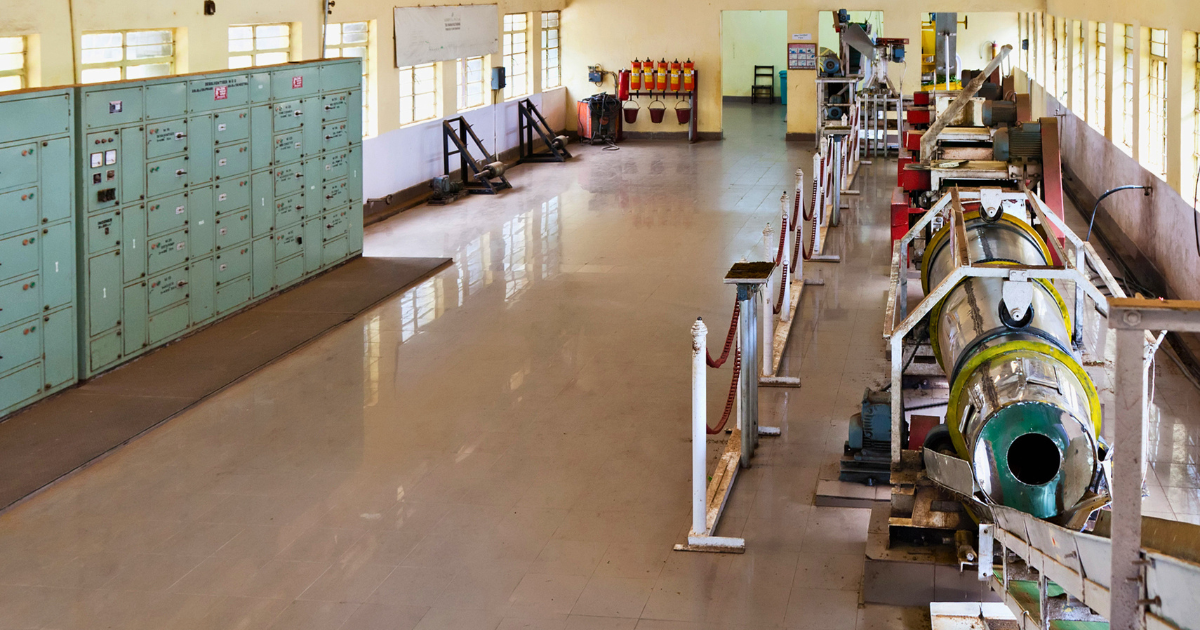
The estates ran their own processing on site, powering early factories before any grid reached the hills.
Is the Munnar Tea Museum worth visiting?
The Munnar Tea Museum is well worth the hour or two it takes, and it makes a good first stop for anyone spending time in the region. It gives the plantations that fill every view around the town a history and a working explanation, so the estates make a great deal more sense afterwards. For a modest entry fee, it adds real context to a visit to Munnar that the scenery alone cannot.
Most visitors find the demonstration and tea tasting the high points in the visit. Watching fresh leaves move through withering, rolling, fermenting and drying, then tasting the result a few minutes later, turns an abstract process into something concrete and memorable. The old machinery and photographs fill in the rest of the story, and staff are on hand throughout to explain what is happening and answer questions.
The museum sits comfortably alongside the rest of a day in Munnar. It pairs naturally with the viewpoints and estate drives nearby, and the shop is a reliable place to pick up tea grown on the surrounding hills before moving on. Arriving earlier in the day, ahead of the busier midday period, gives the demonstration and tasting room to breathe and makes the visit more enjoyable still.
How to plan a visit to the Munnar Tea Museum
The museum sits on the Nallathanni Estate, around 2km to 4km from the centre of Munnar depending on the route, and a taxi or auto-rickshaw from town takes about 10 to 15 minutes. It is closed on Mondays, and opening hours run from 9:00am to either 4:00pm or 5:00pm depending on the season, so it is sensible to confirm the current times before setting out. Entry is modest, around 75 rupees for adults, just over $1 AUD with a small extra charge of about 20 rupees for a camera. The tea processing demonstration usually runs as two scheduled shows, often at 10:00am and 2:00pm, which is worth checking against your plans.
How much time do you need at the museum?
Most visitors spend between one and two hours at the museum, which covers the display rooms, the documentary, the processing demonstration and the tasting at an unhurried pace. The collection is not large, so there is no need to set aside half a day for it. Timing the visit to catch one of the demonstration shows makes the most of the trip, since the live processing is the part that brings the exhibits together.
What is the best time to visit the museum?
Mid-morning is the best time to visit, ideally arriving for the 10:00am demonstration. Kerala tours tend to reach the museum around midday, and the display rooms and tasting counter are more comfortable before then, with the added benefit of lining up neatly with the morning demonstration.
As for the season, the cooler, drier months from October to March suit Munnar best, with clear air and good light across the hills. The monsoon, from around June to August, brings heavy rain that can make the estate roads slow going, though the museum itself stays open and the plantations are at their greenest.
Can you visit the museum and Munnar tea estates on the same day?
The museum and the surrounding estates fit comfortably into a single day, and most visitors see them together. The museum stands on a working estate, so the plantations begin at the door, and the drive in and out passes through the tea gardens it describes. An hour or two inside leaves plenty of time for a longer look at the estates afterward.
A common approach is to start at the museum in the morning, while it is quiet and the first demonstration is on, then spend the rest of the day among the estates, stopping at viewpoints or taking a plantation walk. Seeing how the tea is made first gives the estates more meaning, since the rows of bushes and the distant factories connect to a process already understood.
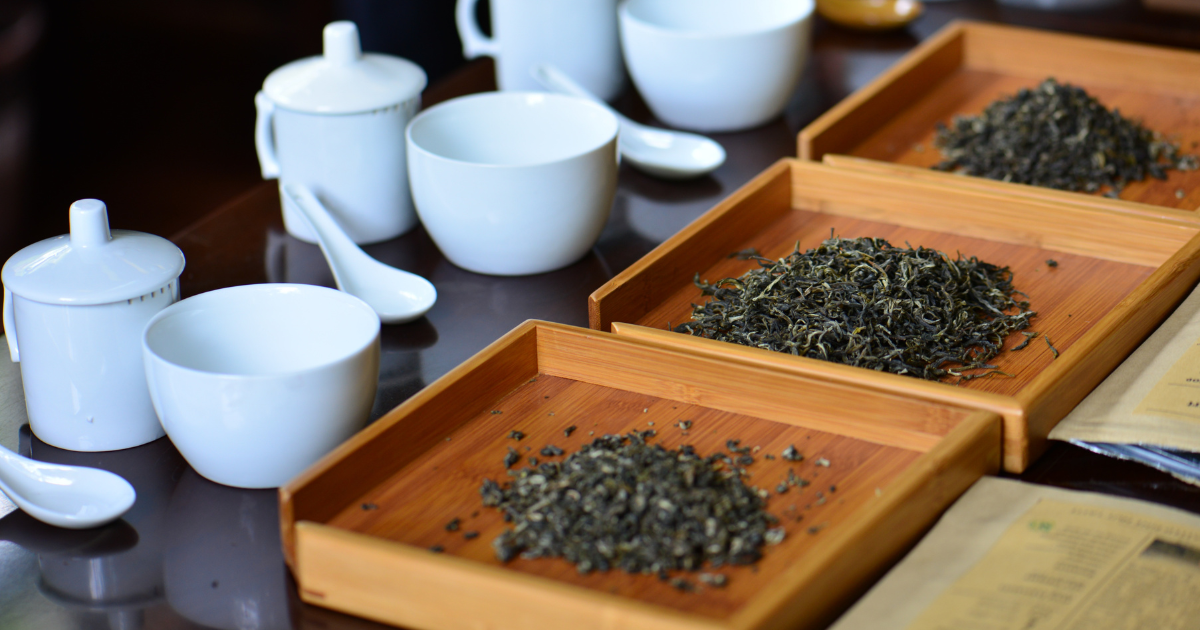
A tasting session of around 100 rupees or just over $1 AUD covers black, orthodox and green grades.
What else can you do near the Munnar Tea Museum?
The museum sits on the road running east out of Munnar towards Mattupetty and the high lakes, which is one of the town's main sightseeing routes. Most of the area's best-known stops lie along this direction, so the museum slots easily into a longer day out rather than standing on its own.
Visit nearby tea estates and viewpoints
The viewpoints around Munnar give the wider sweep of the estates that the museum explains at close range. Photo Point, about 4km from town along the same road, opens onto tea gardens flanked by silver oaks and is one of the easier stops to reach. Pothamedu Viewpoint, around 3km out on the Kochi side, looks over a valley planted with tea, coffee and cardamom, and rewards an early visit before the cloud builds.
Further along the Mattupetty road are the high lakes and dams. Mattupetty Dam, roughly 11km to 13km from town, holds a reservoir ringed by tea slopes where boating is run by the local tourism council, and Kundala Lake sits further on at around 20km, quieter and set among hills, with shikara boat rides on the water. Each makes a natural continuation of the drive past the museum.
Add a guided plantation walk or scenic drive
A guided walk through a working estate is the closest thing to stepping inside the landscape the museum describes. Local guides lead visitors along the rows, explaining how the bushes are pruned and plucked and how the day is organised around the factory, which gives the plucking and processing a human scale that the displays cannot. These walks suit travellers who want to understand estate life rather than simply photograph it.
For those who would rather stay with the views, the roads out towards Top Station and Lockhart Gap run through some of the higher, more open tea country. The drive climbs steadily, with the estates falling away on either side, and Top Station, on the Kerala and Tamil Nadu border, looks out across the hills towards the plains below. A driver who knows the route can time the higher stops for the clearer light of the morning.
Pair the museum with a slower day in Munnar
The town itself repays a slower pace, with the old CSI Christ Church, built by the planters, and the small, busy market among the places that fill an unhurried afternoon. A morning at the museum followed by time in and around the town makes for an easy day that still keeps the focus on tea and its history.
This slower approach also suits the climate, which can turn wet or misty without much warning. Keeping the day flexible, with the museum as its anchor, leaves room to wait out a shower over a pot of tea rather than working through a fixed list of sights in the rain.
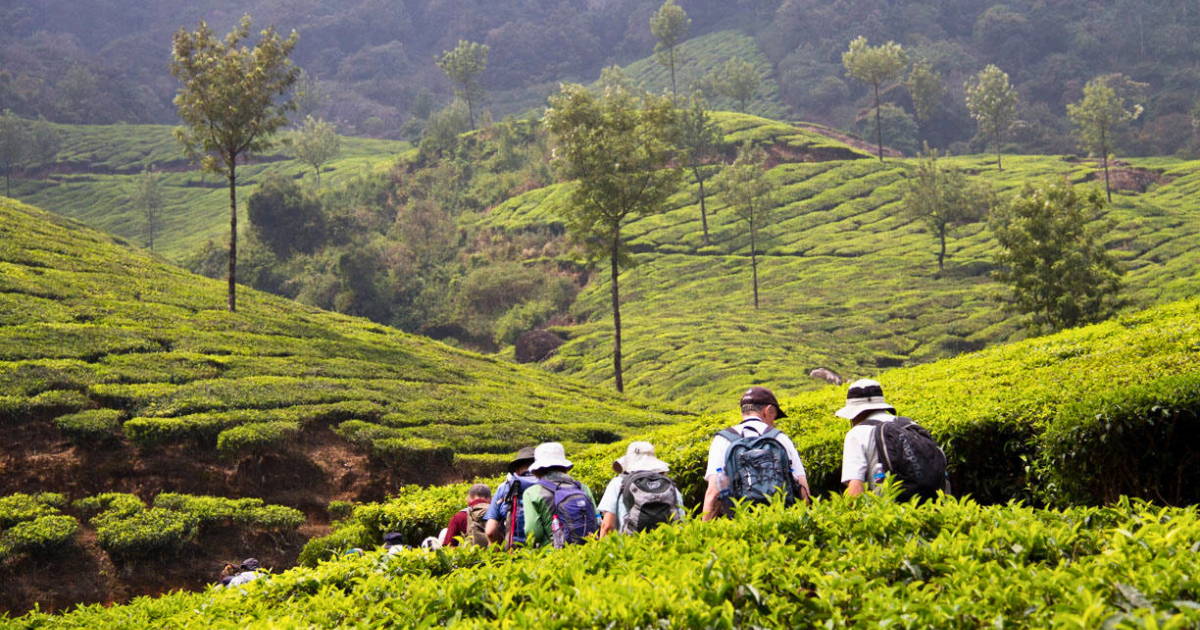
Guided estate walks explain how the bushes are pruned and plucked through the season.
Visit Munnar and its tea estates with India Unbound
India Unbound has designed journeys across India for decades and knows Kerala well. A private journey can take in Munnar and its estates along with the backwaters, the spice hills of Thekkady and the old port of Kochi, built around what interests the traveller. Each journey is arranged with expert local guides and carefully chosen accommodation, from heritage properties to plantation bungalows. Get in touch with India Unbound to begin planning your journey through Kerala.