
Rinchenpong is a small hill town in West Sikkim, surrounded by forested slopes and offering views of the Kangchenjunga mountain range on clear days. Above the town stands Rinchenpong Monastery, one of Sikkim's oldest Buddhist monasteries, established around 1730. For nearly three centuries, it has been part of the region's religious life and remains a place where monks study and practise the teachings of Tibetan Buddhism.
One of the monastery's most distinctive treasures is a rare statue of the Ati Buddha, depicted in blue and embracing a female consort in the yab-yum posture. This image represents the union of wisdom and compassion in Vajrayana Buddhism and is one of the reasons Rinchenpong stands out among the historic monasteries of Sikkim.
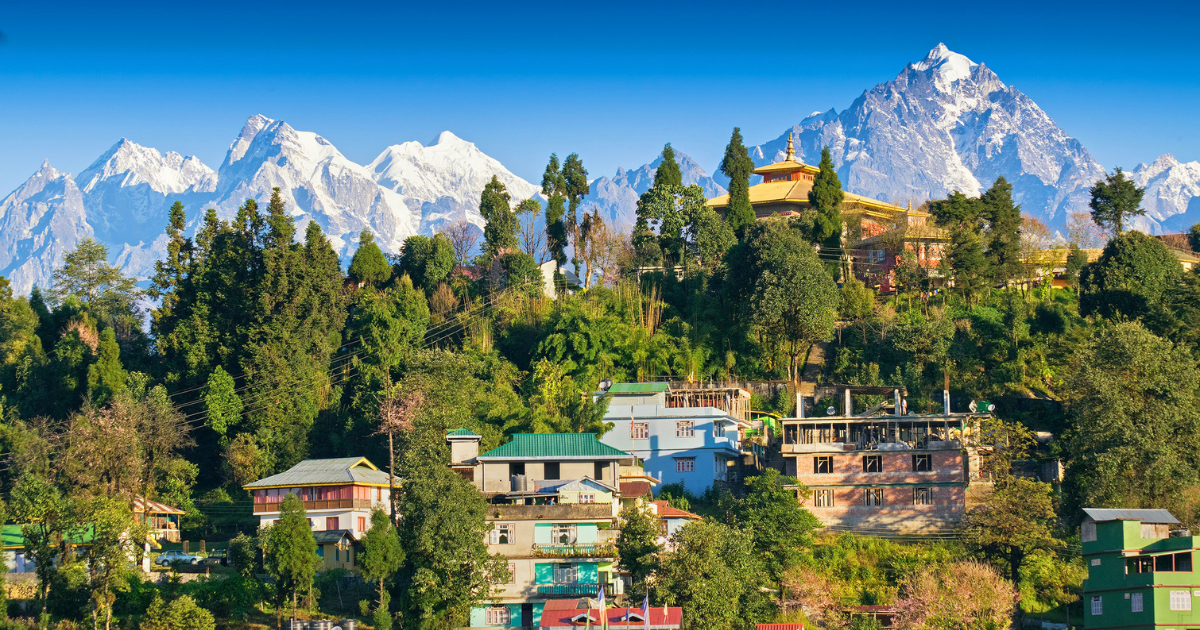
The hills of West Sikkim are known for their mountain scenery, with clearer views often possible in the months after the monsoon.
The history of Rinchenpong Monastery
Rinchenpong Monastery was established during the early development of Sikkim's Buddhist institutions under the Namgyal dynasty. The kingdom was founded in 1642, when three Tibetan Buddhist spiritual teachers, known as lamas, consecrated Phuntsog Namgyal as its first chogyal, or king, at Yuksom. In the decades that followed, monasteries were established across western Sikkim, strengthening the influence of Tibetan Buddhism in the region.
Where is Rinchenpong Monastery?
Rinchenpong Monastery, also known as Sang Ngag Yangtse Monastery, is located in Soreng district, south of Pemayangtse Monastery near Pelling. Both belong to a region with a long history of Buddhist religious activity, dating back to the establishment of the Sikkimese kingdom.
Western Sikkim is also home to several other historic monasteries, including Dubdi, Sangachoeling and Tashiding. Many were established during the kingdom's early years, when Yuksom served as its first capital. Together, these monasteries helped establish the region as an important centre of Buddhist worship and learning.
How old is Rinchenpong Monastery?
Rinchenpong Monastery was founded around 1730, when the Nyingma school of Tibetan Buddhism was already well established in Sikkim. The Nyingma school is the oldest of Tibetan Buddhism's major traditions, tracing its origins to the introduction of Buddhist teachings to Tibet during the eighth century. Its followers place particular importance on teachings passed down through generations of Buddhist masters.
Rinchenpong's religious lineage is associated with Guru Chowang, a 13th-century Tibetan master known as a tertön, or treasure revealer. In the Nyingma tradition, tertöns are believed to rediscover sacred teachings concealed by earlier Buddhist masters for future generations. This lineage was carried forward by later teachers associated with Rinchenpong, including Lama Ugen Gyatso and his son, Lama Rigdzin Thinlay Gyatso, who contributed to the monastery's development.
How has Rinchenpong Monastery changed over time?
Rinchenpong Monastery has undergone several renovations since its foundation, including restoration work supported by the Sikkim government. While many historic monasteries in the region have been substantially rebuilt using modern materials, Rinchenpong has retained its older stone structure.
The renovations have helped preserve the building for continued religious use. Monks still conduct prayers and ceremonies at the monastery, maintaining practices passed down through generations. Although parts of the building have changed, its role as a place of Buddhist worship has continued.
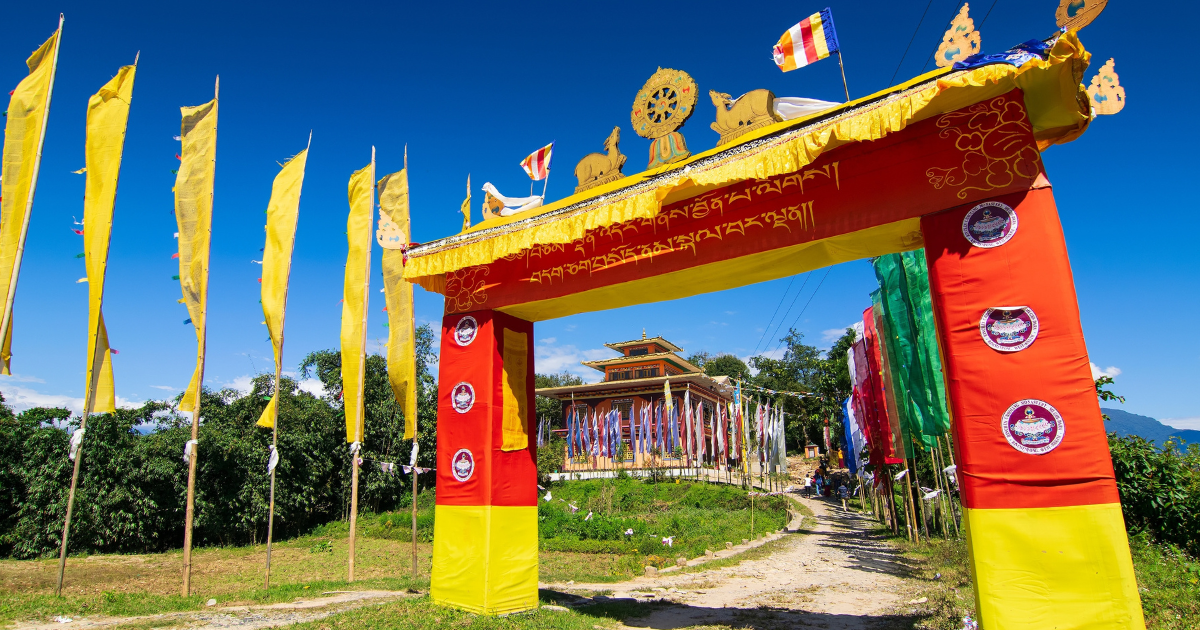
Rinchenpong Monastery preserves elements of Sikkim’s older monastery architecture, including its stone walls and traditional decorative details.
What is special about Rinchenpong Monastery?
Rinchenpong Monastery is best known for its rare statue of the Ati Buddha, a figure associated with some of the most important teachings of the Nyingma school of Tibetan Buddhism. The statue's unusual appearance carries a deeper religious meaning, reflecting beliefs that continue to be studied and practised by the monks who live at the monastery.
The rare Ati Buddha statue
The Ati Buddha statue at Rinchenpong represents the primordial Buddha, a figure known as Samantabhadra in the Nyingma tradition. Unlike Siddhartha Gautama, the historical Buddha who lived and taught in ancient India, Samantabhadra does not represent a person from a particular period in history. Instead, he symbolises the original, enlightened nature of the mind, which Buddhist teachings hold is present in all beings but obscured by ignorance.
In traditional Tibetan Buddhist art, Samantabhadra is depicted with a deep blue body, representing the boundless nature of awareness, much like the open sky. He is generally shown without robes or ornaments, symbolising a state of enlightenment free from attachments. The image at Rinchenpong is especially noteworthy because he appears in an embrace with a female consort, a form known as yab-yum.
The meaning of the yab-yum posture
The yab-yum posture represents the union of two qualities considered essential to enlightenment in Vajrayana Buddhism. The Tibetan term translates to "father-mother" and refers to a male Buddhist figure shown embracing a female consort. Vajrayana Buddhism uses symbolic images, rituals and meditation practices to communicate religious teachings, so the figures' poses and appearances have meanings beyond what they show physically.
In this symbolism, the male figure generally represents compassion, while the female figure represents wisdom, or the understanding of reality's true nature. Vajrayana Buddhism teaches that both are necessary for enlightenment. Compassion guides how a person acts towards others, while wisdom helps overcome ignorance and mistaken beliefs. Their embrace expresses how these two qualities must develop together on the Buddhist spiritual path.
A living centre of Buddhist worship and learning
Rinchenpong Monastery continues to serve as a place of religious education through its sheda, a monastic institution where young monks study Buddhist philosophy. Monastic education is an important part of the Nyingma tradition because its teachings are passed from experienced religious teachers to successive generations of students. At a sheda, monks receive structured instruction in Buddhist texts and philosophy, developing the knowledge needed to understand and continue their religious practices.
The monastery also holds ceremonies throughout the year, following the Nyingma Sangwa Duepa tradition associated with Guru Chowang. These ceremonies form part of a religious lineage that has been maintained at Rinchenpong for generations. While the monastery's historical building and rare statue attract visitors, its educational and ceremonial activities show how the Buddhist traditions associated with the site continue to be practised today.
What can visitors see at Rinchenpong Monastery?
Visitors to Rinchenpong Monastery can explore its traditional Buddhist architecture, see religious artwork inside the prayer hall and walk around the grounds, where prayer wheels and flags remain part of the monastery's religious setting. Although smaller than many of Sikkim's major monasteries, Rinchenpong has several distinctive details that reflect its history and the Buddhist traditions practised here.
The monastery's traditional architecture
Rinchenpong Monastery is a relatively small, two-storey building constructed with stone masonry and timber, materials traditionally used in Sikkim's older monasteries. Its exterior has whitewashed stone walls, red-painted sections and a broad, sloping roof designed to shed the heavy rainfall common in the Himalayan foothills. A staircase along the side leads to the upper floor, while the main entrance opens towards the courtyard.
Above the entrance is a Buddhist emblem showing a golden Dharma wheel between two deer. The wheel represents the Buddha's teachings, while the deer recalls his first sermon at Deer Park in Sarnath, where he taught his first followers after attaining enlightenment. This symbol is common in Tibetan Buddhist monasteries and identifies the building as a place where the Buddha's teachings are preserved and practised.
Inside the main prayer hall
The main prayer hall contains Buddhist statues and religious paintings associated with the monastery's Nyingma tradition. Among these is an image of Guru Padmasambhava, the 18th-century Buddhist master traditionally credited with establishing Vajrayana Buddhism in Tibet. His teachings also became influential in Sikkim, where he is widely revered as Guru Rinpoche. His statue stands in front of the sacred images that include Rinchenpong's rare Ati Buddha.
The prayer hall's colourful wall paintings have been renewed over time, helping preserve the religious imagery used during worship. Alongside the statues on the altar, these paintings depict Buddhist teachers and deities whose identities are expressed through particular colours, gestures and objects.
Prayer wheels and prayer flags
Prayer wheels are positioned on either side of Rinchenpong Monastery's entrance. These cylindrical wheels are decorated with Buddhist symbols and mantras, sacred phrases used in prayers and meditation. In Tibetan Buddhism, prayer wheels are traditionally turned clockwise, following the direction in which devotees walk around sacred Buddhist monuments. Turning a wheel is regarded as a way of accumulating merit and expressing devotion.
The grounds are also marked by tall poles carrying white prayer flags, which are associated with prayers for peace, protection and the wellbeing of others. Buddhist prayers and mantras are printed on the fabric, with the wind traditionally believed to carry their blessings across the surrounding landscape. Behind the monastery stands a chorten, or Buddhist stupa, a religious monument traditionally associated with offerings, remembrance and spiritual practice.
Views of Kangchenjunga and the surrounding hills
The monastery's grounds offer views across the wooded hills of western Sikkim, with the Kangchenjunga range visible when the weather is clear. At 8,586 metres, Kangchenjunga is the world's third-highest mountain, rising along the border between Sikkim and Nepal. Its snow-covered peaks dominate the northern horizon, while layers of forested ridges extend across the valleys below.
Kangchenjunga also holds deep religious importance for the people of Sikkim. The mountain is revered as the abode of a guardian deity believed to protect the land and its communities. This belief is celebrated during Pang Lhabsol, an annual festival honouring Kangchenjunga and the unity of Sikkim's people.
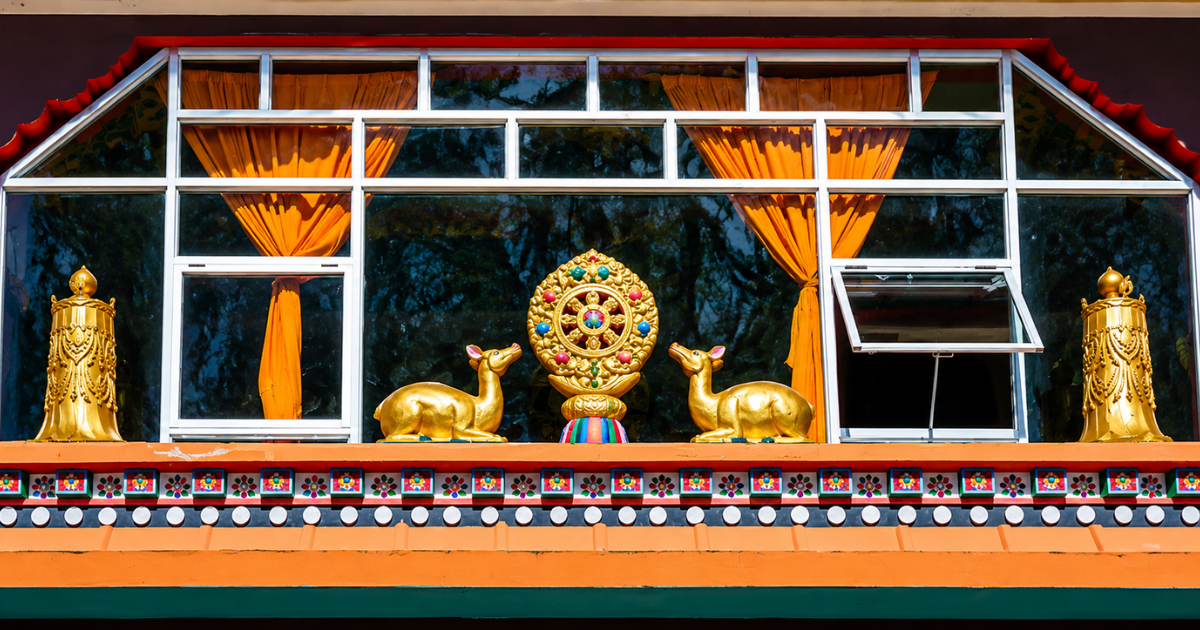
The Dharma wheel and deer recall the Buddha’s first sermon at Sarnath, a symbol widely used in Tibetan Buddhist monasteries.
What should travellers know before visiting Rinchenpong Monastery?
Visiting Rinchenpong Monastery is a chance to experience Buddhist religious life in one of West Sikkim's historic hill communities. The monastery is accessible from Rinchenpong town and can be included in a journey through the region. As it remains an active place of worship, a few local customs are worth understanding before the visit.
How do travellers reach Rinchenpong Monastery?
Rinchenpong Monastery is reached by a short uphill walk from Rinchenpong town, following a path with stone steps through the hillside. The climb is relatively short but has some steep sections, so comfortable walking shoes are recommended. Rinchenpong is accessible by road from nearby Kaluk and Pelling, both of which can be included in a wider journey through West Sikkim. Pelling is also home to Pemayangtse Monastery and the ruins of Rabdentse, the former capital of the Sikkimese kingdom.
For international travellers, visiting Rinchenpong also involves meeting Sikkim's entry requirements. Because the state borders Nepal, Bhutan and Tibet, the Indian government regulates access for foreign nationals. Foreign visitors generally require a Restricted Area Permit (RAP), also called an Inner Line Permit (ILP), in addition to their Indian visa. The permit covers Rinchenpong and other designated tourist destinations, although certain protected areas of Sikkim require additional permission.
Is photography allowed inside Rinchenpong Monastery?
Photography is not permitted inside Rinchenpong Monastery's main prayer hall. The hall houses sacred Buddhist images, including the rare Ati Buddha statue, which monks and devotees regard as objects of worship. Visitors may be able to see these images when the prayer hall is open, visitors should confirm the rules with the monastery before taking any photographs.
Visitors can photograph the monastery's architecture, prayer flags and surrounding Himalayan scenery outside the prayer hall. The grounds provide opportunities to capture the building against the forested hills, particularly when Kangchenjunga is visible. As the monastery remains active, it is courteous to ask permission before photographing monks or devotees and to follow any instructions given by the resident caretakers.
What should visitors wear and how should they behave?
Visitors should wear modest, comfortable clothing when visiting Rinchenpong Monastery, with shoulders and knees covered. Shoes are normally removed before entering Buddhist prayer halls, so footwear that is easy to take off is practical. The uphill approach also makes comfortable walking shoes useful, particularly when the paths are damp after rainfall.
Visitors should speak quietly and avoid interrupting prayers or ceremonies inside the monastery. Sacred statues, offerings and other religious objects should not be touched without permission. When walking around Buddhist shrines or chortens, the customary direction is clockwise, keeping the sacred monument on the right. This practice, known as circumambulation, is a traditional expression of respect and devotion in Tibetan Buddhism.
When is the best time to visit Rinchenpong Monastery?
October to April is generally the best time to visit Rinchenpong Monastery, particularly for travellers hoping to see Kangchenjunga. The months following the monsoon, especially October and November, often bring clearer skies and excellent mountain visibility. March and April are also pleasant, with milder weather and spring vegetation across the surrounding hills. Winter can offer clear views too, although mornings and evenings are considerably colder.
The monastery can be visited throughout the year, although the June to September monsoon brings frequent rainfall and reduced visibility. Morning visits generally offer the best opportunity to see Kangchenjunga before clouds gather around the mountains. Around 1 to 1.5 hours is usually enough for the walk and visit, depending on the starting point and time spent exploring the grounds.
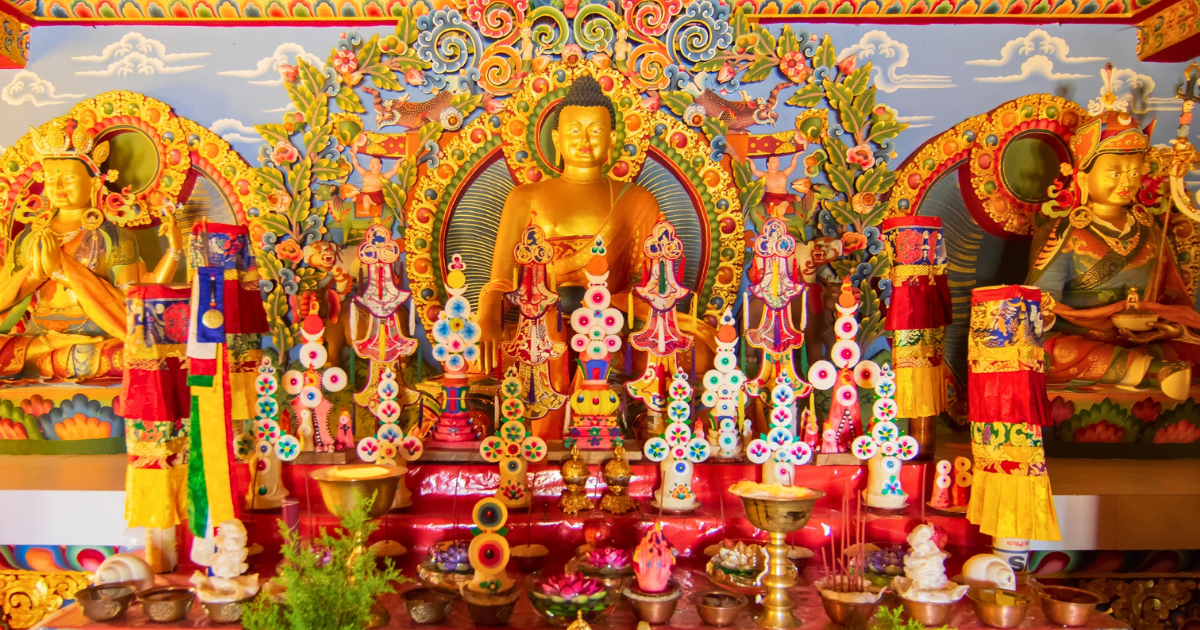
Sacred statues and ceremonial offerings form an important part of Buddhist worship, reflecting the religious traditions preserved at Rinchenpong Monastery.
Explore Sikkim with India Unbound
India Unbound specialises in private journeys across India, creating personalised itineraries that reflect each traveller's interests, pace and preferences. Our journeys offer opportunities to explore India's history, culture and landscapes, from its well-known destinations to lesser-visited regions such as Sikkim. To start planning a journey, get in touch with our team.